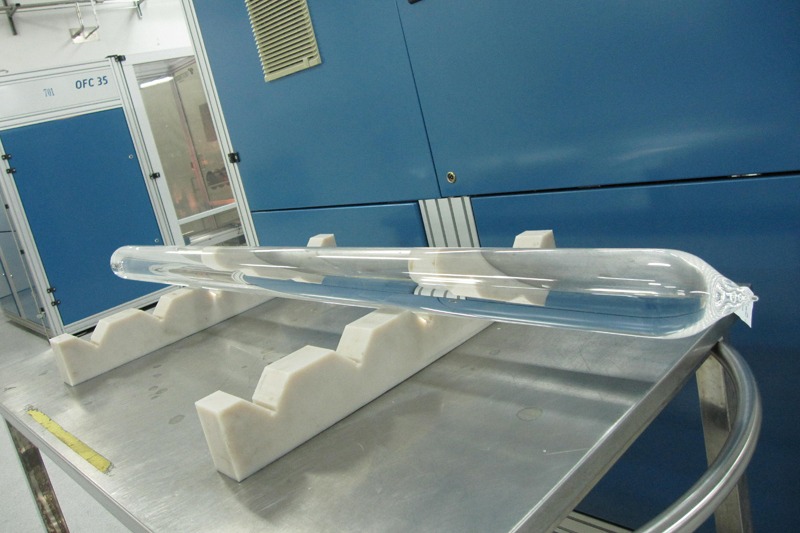
Každý kilometr optického vlákna v každém kabelu v každé síti začínal stejně: jako velká skleněná tyč nazývaná předlisek.
Tato tyč obsahuje celý optický design vlákna – jeho jádro, jeho opláštění, jeho profil indexu lomu, její geometrie. Když ji kreslící věž natáhne až na 125 µm, vlákno zdědí celou tuto strukturu, kilometr za kilometrem, bez úpravy. Předlisek není surovina, kterou rafinujete po proudu. Je to hlavní vzor. Vlákno je jeho kopií.
Na tom záleží daleko nad rámec výrobních drobností. Pokud hodnotíte projekt výroby vláken – pro národní širokopásmový program, dodavatelský řetězec telekomunikačního operátora, průmyslový park, nebo soukromá výrobní investice – předlisek je
- kde začíná schopnost upstream,
- kde žije nejvyšší technická bariéra,
- kde se soustřeďuje největší podíl hodnoty vlákenného řetězce.
Jeho pochopení mění způsob, jakým hodnotíte dodavatele, porovnat nároky na způsobilost, a seřadit výrobní investici.

Co je předlisek z optických vláken?
Předlisek z optického vlákna je pevná tyč z vysoce čistého křemičitého skla s precizně navrženou strukturou indexu lomu. Střed je jádro – dotováno, aby neslo vyšší index lomu. Vnější vrstvou je plášť – vyrobený s nižším indexem lomu. Tento rozdíl je to, co zachycuje světlo uvnitř jádra prostřednictvím úplného vnitřního odrazu během přenosu signálu.
Moderní telekomunikační předlisky jsou velké. Průměry se pohybují od zhruba 150 mm pro střední výrobu až po více než 300 mm pro největší komerční systémy. Délky obvykle běží 2 na 6 metrů. Z jednoho předlisku této velikosti, a drawing tower can produce 8,000 na 10,000 kilometers of 125µm bare optical fiber in a continuous run.
Size matters for an economic reason: longer, more consistent preforms mean fewer tower changeovers, higher utilization, and lower cost per kilometer of drawn fiber. A preform that runs 10,000km before changeover contributes differently to a plant’s economics than one that runs 3,000km—even if both meet the same optical specification on paper.
The glass composition determines everything the fiber can do: how much signal it loses per kilometer, how it behaves under bending, how it splices and terminates, and whether it will hold those properties across temperature cycles and years in the field. No step downstream can rewrite the glass.
The Manufacturing Chain: Where Preform Sits and Why Position Matters
Optical fiber manufacturing is a vertical chain. Each link has a different capital requirement, a different technical barrier, and a different level of upstream control:
| Level | What it produces | Input it depends on | Technical barrier | Entry speed |
| Výroba předlisku | The large glass rod — the optical master | High-purity chemicals, quartz, process know-how | Nejvyšší | Slowest |
| Kreslení vláken | 125µm coated bare fiber | Preforms (purchased or made) | Medium | Medium |
| Cable manufacturing | Fiber optic cable ready for installation | Drawn fiber (purchased or made) | Lowest | Fastest |
Most fiber optic cable factories in the world sit at the bottom of this table. They buy drawn fiber from a smaller group of drawing-tower operators, who in turn source preforms from a far smaller pool of manufacturers. The number of serious preform producers globally is counted in dozens. Cable factories are counted in thousands.
That is not a coincidence. It is a direct reflection of how technically and operationally difficult sustained preform production is—and why owning that capability, or having a credible path to access it, gives a fiber manufacturer a fundamentally different position in the market than a cable assembler.
Preform, Bare Fiber, and Fiber Optic Cable: Three Different Things
These terms appear in the same conversations and the same supplier brochures. They are not interchangeable. Confusing them leads to wrong buying decisions and wrong investment logic.
| Předlisek z optických vláken | Bare optical fiber | Optický kabel | |
| Physical form | Glass rod, 150–300mm+ diameter, metrů dlouhé | Glass strand, 125um, with UV-cured polymer coating | Assembly of fibers in tubes, with strength members and jacket |
| What it determines | The fiber’s optical DNA: útlum, disperze, RI profile, geometry | Signal performance in service; coating protects against microbending | Mechanical survival: installation load, voda, rozdrtit, teplota |
| Who makes it globally | A few dozen serious producers | Drawing-tower operators—far more than preform makers | Thousands of cable factories |
| Investment barrier | Highest—deposition systems, clean process, long ramp-up | Medium—tower, coating line, měření | Lowest—stranding, extrusion, jacketing |
| What a buyer actually acquires | Manufacturing capability, or the highest-value input to a fiber plant | The transmission element inside every cable | A finished, installable product |
| Where value concentrates | Most of the fiber chain’s margin lives here | Middle layer | Thinnest margin, highest competition |
The commercial implication is blunt: a cable manufacturer that buys fiber on the open market captures the most replaceable position in the chain. A company that sources or produces preforms sits upstream of that dependence.

Four Preform Properties That Travel Into Every Kilometer of Fiber
Preform quality does not stay in the factory. It travels into every reel you ship and every splice your customer makes in the field.
Refractive index profile. The shape of the index gradient across the core defines bandwidth in multimode fiber and dispersion characteristics in singlemode. PCVD’s ability to deposit thousands of precise layers is why it dominates OM4 and OM5 production. VAD and OVD achieve the uniformity that drives ultra-low-loss singlemode. A profile that deviates from specification cannot be corrected after the preform is sintered.
Soustřednost pláště jádra. The center of the core must sit at the center of the cladding within tight tolerances. Concentricity error propagates into every connection the fiber makes: splice loss goes up, výtěžky konektorů klesají, a montéři v terénu hlásí problémy, které vypadají jako jejich vlastní zpracování, ale vycházejí z geometrie skla v továrně.
Čistota a OH kontrola. Nečistoty přechodových kovů a hydroxylové skupiny absorbují světlo o charakteristických vlnových délkách. Kontaminace OH vytváří vrchol vody poblíž 1383 nm. Tyto kontaminanty se dostávají během výroby předlisku – jakost suroviny, prostředí depozice, dehydratace, a slinovací atmosféra, to vše přispívá. Kreslící věž nemá žádný mechanismus k jejich odstranění.
Konzistence geometrie napříč šaržemi. Předlisek, který se táhne čistě na konec své délky, várka po várce, má větší hodnotu pro výrobní linku než linku se stejnými optickými specifikacemi, ale proměnlivým průměrem nebo kvalitou povrchu. Consistency is what makes production economics predictable and what makes a drawing-line operator willing to build supply relationships around a specific preform source.
The Real Barriers Behind Preform Manufacturing
Preform production is not difficult because of any single hard step. It is difficult because it requires every step to work well simultaneously and consistently—and the feedback loops are slow.
Deposition chemistry. MCVD, PCVD, OVD and VAD each react ultra-pure silicon tetrachloride (SiCl4) and germanium tetrachloride (GeCl4) to build doped silica at sub-micron compositional control. Each method manages that chemistry differently, and each has failure modes that only show up in the drawn fiber—sometimes thousands of kilometers into a production run. The optical fiber preform manufacturing methods comparison goes deeper on where each process fits.
Process environment. Contamination measured in parts per billion is enough to shift attenuation measurably. Moisture exclusion, gas purity, furnace atmosphere, and clean handling of partially built rods are not secondary concerns. They are the difference between a preform that draws to G.652.D specification and one that consistently misses.
Capital and ramp-up cycle. Deposition equipment, sintering furnaces, profile measurement, drawing trial capacity—each needs to be in place before the first saleable preform comes out. More critically, the process tuning cycle is long. Recipes that work in a pilot run often need adjustment at production scale. The ramp from first glass to stable, qualified output is measured in quarters, not weeks.
Talent. The process requires engineers who understand glass chemistry, vapor deposition dynamics and optical metrology. This expertise does not transfer easily from adjacent fields. It takes time to build in a new location—and the ramp-up timeline almost always runs to the pace of the team, not the schedule.
Measurement infrastructure. Refractive index profilers, geometry measurement systems, attenuation test beds, and drawing trial facilities are not optional. Without them, you cannot qualify output, debug process drift, or build the data record that proves consistency to downstream customers.
Cable Line, Drawing Line, or Preform Line: A Decision Framework
A preform line is not the right first step for every fiber manufacturing project. That is not a hedge—it is an engineering and economic reality, and stating it clearly is the mark of a supplier who thinks about your outcome rather than their equipment sale.
| Dimenze | Cable line | Fiber drawing line | Preform line |
| What you build | Fiber optic cable from purchased fiber | Bare fiber from purchased preforms | Preforms from chemical inputs |
| Revenue start | Fastest | Medium | Slowest |
| Operating risk | Lowest | Medium | Nejvyšší |
| Upstream supply dependence | High—fiber price and availability | Medium—preform supply | Lowest—commodity chemicals |
| Margin position | Thinnest | Middle | Deepest |
| Best fit for | Entry-level local manufacturing programs; rapid market access | Proven demand; import cost reduction; supply security | Strategic programs; long investment horizon; national capability building |
| Most common mistake | Treating cable assembly as “fiber manufacturing” | Underestimating preform supply qualification lead time | Underestimating ramp-up, talent pipeline, and QC system requirements |
Add a drawing line when fiber demand is proven and preform supply is negotiated. Evaluate preform manufacturing when volume, strategie, or supply security concerns justify the investment and the team is ready.
Some programs skip phases for strategic reasons—a government program targeting supply-chain independence, například, may choose to enter at the drawing or preform level from the start. Those decisions are defensible. They just require eyes-open planning about the longer horizon and larger support requirements.
Ten Questions to Answer Before Any Equipment Discussion
Jumping to equipment specifications before the project is defined is how manufacturing programs get mis-sized, over-committed, or delayed. A serious technology partner should want answers to these before recommending anything.
| # | Otázka | Why it cannot be skipped |
| 1 | What is the confirmed demand for your fiber output—local, regional, or export? | Demand determines whether the line justifies its cost |
| 2 | What fiber types does your market need: G.652.D singlemode, G.657 bend-insensitive, vícerežimový, specialty? | Fiber type constrains which preform process makes sense |
| 3 | Is your entry point cable, výkres, or preform—and is that a settled decision or still open? | This question reframes every downstream specification |
| 4 | What is your annual volume target at stable production, and what is your first-year projection? | Line sizing, preform diameter, and equipment count all follow from this |
| 5 | What precursor chemicals and quartz can you source locally—and at what purity and volume? | Supply security for inputs is a project risk, not just a cost line |
| 6 | What utilities can your site guarantee: power stability, pure gas, clean water, environmental compliance? | Site constraints can eliminate certain process routes before any other evaluation |
| 7 | Who will run the process—is there a technical team, and how will expertise be built or transferred? | Talent timeline is usually the governing constraint, not equipment delivery |
| 8 | What is your ramp-up acceptance criterion—what does “stabilní, qualified output” mean for your program? | Without this, the project has no definition of done |
| 9 | Will your preforms feed an in-house drawing line, external customers, nebo obojí? | Downstream fit determines required preform dimensions and drawing compatibility |
| 10 | What technical and operational support do you need during installation, commissioning and the production qualification phase? | Support scope is often underestimated and undersourced |
A partner who answers these questions with you before proposing specifications is thinking about your production outcome. One who leads with machine data is thinking about their sale.
How Fibconet Approaches Fiber Manufacturing Projects
Fibconet works on both sides of the fiber value chain. On the cable and component side, Fibconet manufactures finished fiber optic cable and passive components for telecom, FTTH and related applications. Na straně proti proudu, Fibconet supports manufacturing programs that need more than finished product.
For fiber production projects, Fibconet’s scope covers:
- Preform technology solutions — process route evaluation, preform supply, and technical support for programs building or expanding preform capability. Fibconet’s preform supply uses VAD or PCVD core rods with RIC sleeving cladding, engineered for long-length drawing and consistent geometry.
- Original equipment procurement — equipment sourcing and configuration support for preform-related production, matched to your target fiber type, volume, and process route.
- Optical fiber draw towers — drawing line equipment for converting preforms into coated 125µm fiber.
- Complete production line support — end-to-end assistance in establishing a fiber production line, from raw material inputs through drawing, povlak, testování, and initial production qualification. See the full scope on our Tovární dodávka předlisku pro zařízení s optickými vlákny strana.
The right configuration for any project depends on your target fiber types, planned capacity, site conditions, team readiness, and investment horizon.
Fibconet’s approach is to engage on those requirements first and recommend a configuration second.
If you are at the early stage of evaluating a fiber manufacturing investment, the most productive first conversation is a technical requirements discussion—not an equipment quotation.
For the complete chain from raw precursors through drawing, coating and cable integration, a optical fiber manufacturing process guide covers each stage with the same buyer-facing perspective.