Fiber Pigtail vs Patch Cord: Connector Soarten, Ferlies Specs en hoe te kiezen
Ferlykje Fiber Optic pigtails en patch koarden troch Anschluss einen, ynstallaasje metoade, ferlies easken, applikaasjes en RFQ spesifikaasjes.
Diel dit berjocht
A fiber optic pigtail carries a factory-terminated connector on one end and bare fiber on the other, so the bare end gets fusion-spliced into your network.
A fiber patch cord carries a connector on both ends and plugs straight into equipment.
That single structural difference decides where each one belongs, what you pay for it, and which specs you need to state on a purchase order.
This guide is for anyone specifying or reselling these two products: FTTH installers deciding what goes into an ODF tray, distributors building a stock list, and procurement teams writing acceptance terms into a contract.
Eigenskip
Fiber Pigtail
Fiber Patch Cord
Connector ends
One connector + one bare end
Connectors on both ends
Ynstallaasje
Fusion-spliced
Plug-en-play
Typical diameter
0.9 mm
2.0 of 3.0 mm
Main location
ODF, splice-kraan, closure
Equipment rack, patch paniel
Reconnection
Permanent
Reconfigurable
Typysk gebrûk
Cable termination
Equipment interconnection
The One-Sentence Difference, and What It Costs You to Get Wrong
One end versus two ends sounds trivial. On a purchase order it is not.
Order fiber optic pigtails when a technician will splice them into the network permanently.
Order fiber patch cords when someone will plug and unplug the link during commissioning or maintenance.
Send fiber pigtails to a site with no fusion splicer and the crew stops working.
Send patch cords into a splice tray and the installer either coils an unusable second connector inside the tray or cuts it off, which wastes the money you paid for that termination.
The rest of this guide covers how each one is built, the loss numbers to demand, how end-face quality gets verified, and a checklist you can paste into your next RFQ.
What a Fiber Optic Pigtail Is, and Where It Actually Goes
A fiber optic pigtail is a short length of tight-buffered fiber, typysk 0.9 mm, with one connector already installed and polished at the factory. The other end arrives as bare fiber under a protective sleeve. That bare end is not an unfinished product. It is the entire point.
The bare end is the design, not an omission
Fusion splicing joins two fiber cores by melting them into one continuous waveguide. In mated connector pear, tsjinstelling, hâldt twa gepolijst ferrules oantlit ta oantlit en fertrout op meganyske alignment. Beide passe ljocht. Se dogge net itselde.
In splice foeget in fraksje fan it ferlies dat in mated connector pear foeget. Op in keppeling mei ferskate distribúsje punten, kieze splices oer connector pearen by elke krúspunt feroaret de totale optyske budzjet. It beëinige ein fan in patchkoord ôfsnije en wat oerbliuwt, wurket elektrysk, mar jo betelle foar in ferbiner, in ferrule en in polishing syklus dy't bedarre yn in skrap bin.
Guon leveransiers list fiber pigtails as fleanende leads. Itselde produkt, ferskillende regionale gewoante.
Wêr fiber pigtails hearre
Jo sille fine glêstried pigtails binnen:
ODF splice trays: de connector rjochtet de patchpaneladapter, and the bare end splices to the incoming trunk cable
Splice closures and termination boxes: joining outdoor cable to indoor connectivity
Fiber distribution boxes in FTTH: splitter outputs and subscriber drops
In each case the assembly sits behind a panel and never gets touched again. That is why nobody pays for a second connector on it.
Wat is in Fiber Patch Cord, and Where It Actually Goes
In fiber patch cord hat in ferbining oan beide úteinen en in swierdere jas om 'e fiber. Standert diameters rinne 2.0 mm en 3.0 mm, tsjin de 0.9 mm typysk foar in fiber pigtail.
Equipment jumpers en cross-ferbinings
Patch koarden keppelje transceivers oan patch panielen, ferbine ien paniel haven oan in oare, en rinne tusken apparatuer binnen in rek. Oeral dêr't in minsklike hân rûtes, re-routes of unplugs in keppeling, de baan freget om in patch cord.
Wêrom is de jas dikker
De ekstra jas is net padding foar syn eigen wille. In patchkabel wurdt troch kabelbehearders lutsen, bûgd om rek hoeken, stapte op by in rekbou, en unplugged ferskate kearen oer syn tsjinst libben. Aramid garen sterkte leden plus a 2.0 of 3.0 mm bûtenjas absorbearret dy ôfhanneling lading sadat it glês fan binnen nea draacht it.
A fiber pigtail spends its life immobile inside a closed tray, so it does not need any of that.
“Patch Cord” vs “Patch Cable”: An Expensive Word Mix-Up
Two different products share almost the same name, and RFQs suffer for it.
In fiber, patch cord, patch cable and jumper all describe the same thing: a fiber assembly with connectors on both ends. In structured copper cabling, a patch cable means an Ethernet cord with RJ45 plugs, Cat5e through Cat8. Search either term alone and results mix both worlds.
If your quote request says only “20 patch cables, 3 m,” a supplier has to guess. State the medium and the connector explicitly:
20 pcs, fiber patch cord, LC/UPC to SC/UPC, single-mode G.652.D, simpleks, 2.0 mm LSZH, 3 m
That line cannot be misread. The same applies in reverse when you order copper.
How Fiber Pigtails and Patch Cords Are Actually Made
A description circulating on supplier sites, including an earlier version of this page, claims a patch cord is two fiber pigtails cut in the middle and fitted with connectors on both ends. That is not how either product leaves a factory.
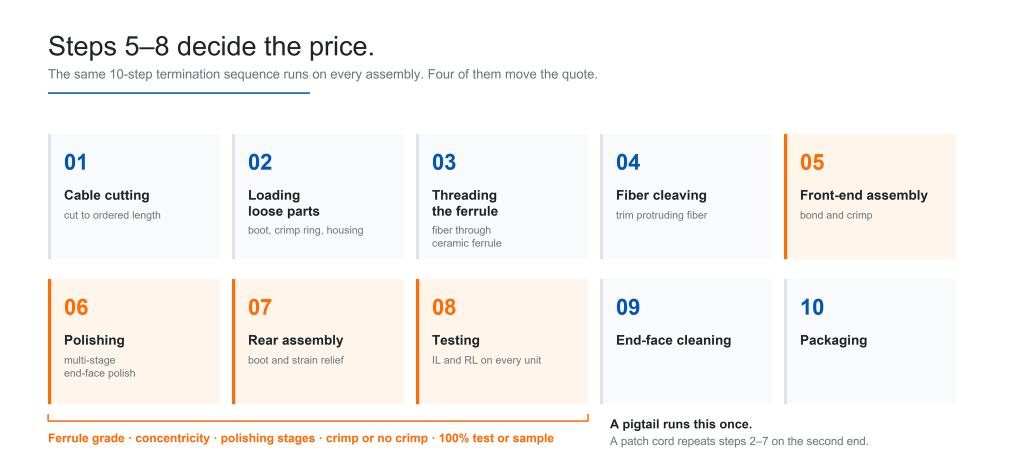
Both run down the same production line at our plant, and the line starts from finished cable:
Cable cutting: cut simplex or duplex cable to the ordered length
Loading loose parts: thread boot, crimp ring and connector housing onto the cable
Threading the ferrule: feed the stripped fiber through the ceramic ferrule
Fiber cleaving: trim the protruding fiber
Front-end assembly: bond and crimp the ferrule and connector body onto the cable
Polijsten: multi-stage polish of the ferrule end-face
Rear assembly: fit the boot and strain-relief components
Testen: insertion loss and return loss on every unit, and units that fail return to polishing
End-face cleaning
Ferpakking
A fiber optic pigtail runs the identical sequence, terminated on one end only. A fiber patch cord repeats steps 2 through 7 on the second end. Nothing gets cut in half at any point.
Now the manufacturing sequence explains the quotes you have been comparing.
A patch cord repeats the entire termination sequence twice, so its labour and consumable cost sits well above a fiber pigtail of the same length and grade. Between two quotes for the same nominal patch cord, the spread comes from what happens inside steps 5 through 8: ferrule grade and concentricity, how many polishing stages the line runs, whether crimping happens at all, and whether every unit gets tested or only a sample does.
That last group is where cheap product is made cheap, and none of it appears on a datasheet.
Real-World Scenario:The most common connector failure we see returned is a housing that has pulled apart from the cable. Nearly every time, the root cause is the same: the assembler skipped crimping at the front-end assembly stage to save cost. Without a crimped ring locking the aramid yarn to the connector body, every pull on that cord transfers straight to the glass. The cord tests fine at the factory bench and separates the first time a technician tugs it in a rack.
The Spec Matrix: Connector Type, Poalsk, Fiber and Where Each Belongs
Most selection guides stop at “one end or two.” Below is the full cross-reference: connector family, Poalsk, fiber type, which form each combination normally ships in, and where it belongs.
Connector
Poalsk
Fiber type
Usual form
Wêr't it heart
SC
UPC
Single-mode G.652.D
Pigtail and patch cord
FTTH distribution boxes, ODF panels, ONT connections
SC
APC
Single-mode G.652.D / G.657.A2
Pigtail and patch cord
PON links, GPON splitter outputs, RF video overlay
LC
UPC
Single-modus, or OM3 / OM4 multimode
Mostly patch cord
Transceiver connections, high-density panels, data centre racks
LC
APC
Single-mode G.652.D / G.657.A2
Mostly patch cord
High-density PON, wavelength-sensitive links
FC
UPC of APC
Single-modus
Pigtail and patch cord
Test apparatuer, measurement benches, legacy telecom racks
ST
UPC
Single-modus, or OM1 / OM2 multimode
Pigtail and patch cord
Legacy LAN, industrial and building networks
MPO / MTP
UPC of APC
OM3 / OM4 multimode, of single-modus
Patch cord (trunk assembly)
40G / 100G / 400G data centre backbone
Two notes on reading this table. LC and SC in single-mode cover the large majority of FTTH and access-network orders; FC and ST show up mainly in test benches and legacy plant. And MPO belongs to a different design conversation altogether, since it carries 8, 12 of 24 fibers in one ferrule — our guide toMPO to MPO patch cord selectioncovers polarity and fiber-count planning.
If you are matching connector families across a mixed installed base, our note onLC fast connectorscovers the field-termination alternative.
Every combination in the table above is available across ourpatch cord and pigtail range, including mixed-connector assemblies such as LC to SC.
Loss Specifications: The Numbers to Ask a Supplier For
Two numbers govern optical performance on these assemblies. Both get quoted loosely, so it pays to know what you are reading.
Insertion ferlies, and what the number actually measures
Insertion loss is how much optical power disappears when light crosses the joint, in dB. Lower is better.
Our standard single-mode fiber pigtails and patch cords ship at≤ 0.3 dB ynfoegje ferlies, verified on every unit. Boud mei 0.3 μm concentricity ferrules for test-cord applications, deselde gearkomsten berikke≤ 0.15 dB.
Foardat jo dat fergelykje mei in oar sitaat, kontrolearje wat it oare nûmer telt. In dB-figuer op in leveransierside kin elk fan trije ferskillende dingen beskriuwe:
In inkele fúzje splice: it leechste oantal beskikber, en hielendal gjin connector spec
Ien mated connector pear: twa ferrules face to face, dat is wat in patch cord eins leveret yn tsjinst
In splice plus in ferbiner kombinearre: in fiber pigtail spliced yn in keppeling, doe mated by it paniel
Dizze binne net útwikselber. In side dy't in splice-allinich figuer oanhellet neist in ferbiningsprodukt fergeliket ferskate mjittingen. As twa leveransiers ferskine mei in faktor fan twa, dat allinnich ferantwurdet it gat ferrassend faak. Freegje nei hokker fan 'e trije in oanhelle figuer ferwiist foardat jo it as fergelykber behannelje.
Werom ferlies: why UPC and APC are not the same number
Return loss measures how much light reflects back toward the source. Higher is better. The polish geometry on the ferrule end-face drives it.
Poalsk
End-face geometry
Our specified return loss
Typysk gebrûk
UPC
Domed, polished perpendicular to the fiber axis
≥ 50 dB
Ethernet links, general FTTH distribution, data centre
APC
Domed and angled at 8°
≥ 55 dB
MOAN, RF video overlay, any wavelength-sensitive link
The 8° angle on an APC ferrule reflects stray light out into the cladding instead of straight back down the core, which is why it outperforms UPC on return loss.
You will find APC connectors advertised at ≥ 60 dB. Treat a number that high with some care: sustaining it across full production volume, rather than on a hand-picked sample, is a different proposition from hitting it once on a test bench. We publish ≥ 55 dB om't dat it sifer is dat wy hâlde op elke ienheid dy't wy ferstjoere. As in spesifikaasje foar weromferlies fan belang is foar jo linkbudzjet, freegje oft it oan jo oanhelle getal in produksjegarânsje is as in best-case mjitting, en freegje hokker persintaazje ienheden der tsjin wurde hifke.
Wat bart der as jo mate APC oan UPC
In APC-connector sil fysyk in UPC-adapter ynfiere op de measte connectorfamyljes. Neat snapt. Dat is krekt wat dizze flatermodus djoer makket.
It 8 ° hoeke gesicht moetet in plat gesicht. Se kinne gjin fysyk kontakt berikke oer de kearn, sadat der in luchtspleet iepenet tusken de beide ferrules. Ynstekken ferlies klimt, werom ferlies ynstoart, en de keppeling falt direkt of rint marzjinaal en sakket ûnder lading. Minder, twingt de mate kin krassen de gepolijst gesichten fan beide Anschlüsse, dus jo hawwe no ek de goede skansearre.
Yn it fjild, kleur is dyn earste kontrôle. Griene boot of húsfesting betsjut APC; blau betsjut UPC op single-modus. As jo ien fan elk hâlde, se geane net tegearre, wat de adapter jout.
End-Face Quality: De akseptaasjekontrôle hast gjinien spesifisearret
Insertion ferlies en werom ferlies fertelle jo hoe't in gearkomste útfierd op in test bank. End-face condition fertelt jo oft it sil bliuwe útfiere nei in technikus behannelet it. De measte leveransierssiden slaan dit hielendal oer, en it is de kontrôle dy't skiedt in snoer dat oerlibbet in rek út ien dy't net.
Wat IEC 61300-3-35 grades
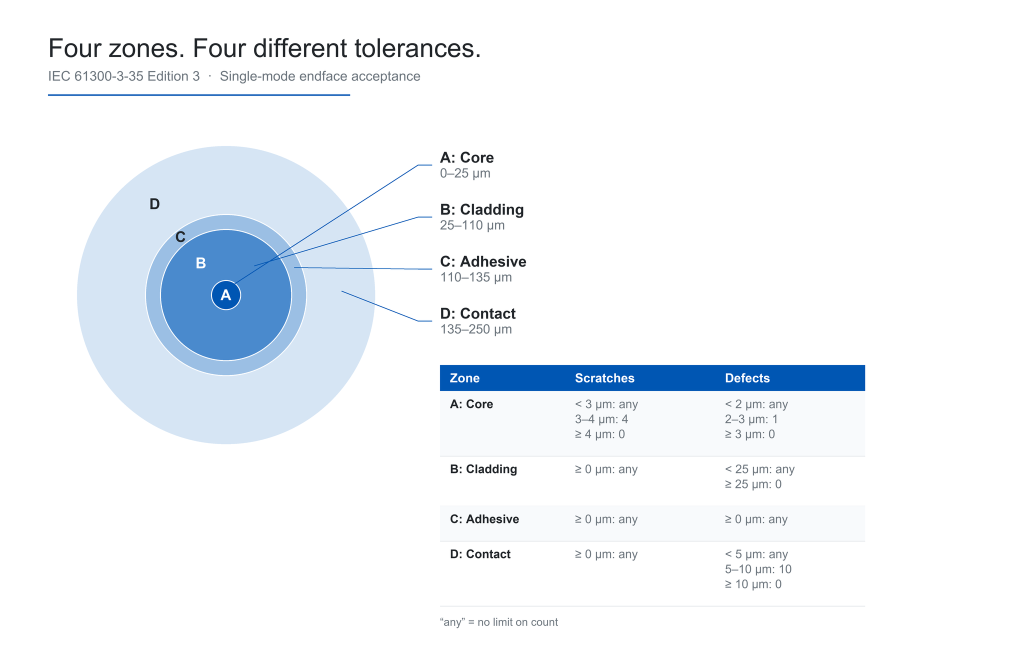
IEC 61300-3-35 is de ynternasjonale standert foar fisuele ynspeksje fan Fiber Optic Connector ein-gesichten. Yn stee fan ien pas of mislearje, it divides the end-face into concentric zones and applies different tolerances to each:
Core zone: the light-carrying region, where the standard is strictest. Scratches and defects here directly degrade the signal
Cladding zone: surrounds the core, with limited defects permitted
Adhesive zone: the epoxy ring around the fiber, more tolerant still
Contact zone: it bûtenste ferrule gebiet dat fysyk rekket syn mate, dêr't pún hâldt de twa gesichten útinoar
Binnen elke sône stelt de standert aparte grinzen yn foar krassen en foar defekten lykas pits, chips en fersmoarging, skalearre troch grutte. In dieltsje sitten yn 'e kontakt sône kin foarkomme fysyk kontakt oer de kearn sels as de kearn sels sjocht der skjin, dat is wêrom sône-basearre grading slacht in ienfâldige fisuele ien kear-over.
Hoe't wy ynspektearje, en wat jo kinne oanfreegje
Elke fiber pigtail en patch cord dy't ús line ferlitte giet troch ein-gesicht ynspeksje op in Dimension EasyCheck V2 ynspeksje mikroskoop, plus ynfoegje ferlies en werom ferlies testen op in ILRL-3327 test stasjon. Beide binne 100% ynspeksjes, net sampling, en QC rint in ekstra sampling kontrôle boppe. Units failing either check return to the polishing stage rather than shipping.
Test reports and 3D interferometry data are available on request as an additional service. They do not ship with a standard order by default, so if your acceptance procedure requires documentation, state it at the quotation stage rather than after the goods arrive.
Pro Tip foar keapers:When you receive a shipment, inspect a sample of end-faces before the cords go anywhere near live equipment, and clean every connector before first mating regardless of how it looks. A 200× or 400× handheld inspection scope costs a fraction of one transceiver. Debris transfers from a dirty connector to a clean one on contact, so a single contaminated cord can propagate through a patch panel one port at a time.
Choosing Between Them: Scenario Decision Table
Where you are working
What you need
Wêrom
Typical connector and polish
Common mistake
ODF splice tray
Fiber pigtail
Bare end splices to the trunk; the connector faces the panel adapter
SC/UPC or SC/APC, single-modus
Ordering patch cords, then cutting one end off on site
Splice closure or termination box
Fiber pigtail
Permanent joint to outdoor cable, no re-plugging after commissioning
SC/APC, single-modus
Ordering fiber pigtails too short to reach the splice tray
FTTH fiber distribution box
Fiber pigtail, plus patch cords for drops
Splitter outputs splice in; subscriber drops need re-patching
SC/APC on the PON side
Mixing APC and UPC inside one enclosure
Equipment to patch panel
Patch cord
Gets unplugged during commissioning and maintenance
LC/UPC, single-mode or OM4
Specifying 0.9 mm cable where 2.0 mm handling strength is needed
Inside a data centre rack
Patch cord
Dense routing, frequent moves, foeget en feroarings
LC/UPC duplex, or MPO trunk
Under-ordering length, forcing tight bends at rack corners
Test bench or commissioning kit
Patch cord, test-grade
Reference cords need low, stable loss across thousands of mating cycles
FC or SC, matched to the instrument
Using a standard production cord as a reference cord
Before You Request a Quote: The Parameter Checklist
Most re-quotes and wrong shipments trace back to a spec that never made it into the original enquiry. Fiber type and cable diameter go missing more than anything else. Stjoer dizze tolve rigels en in leveransier kin offere sûnder in ferfolch-e-mail:
Produkt: fiber pigtail of fiber patch cord
Connector, ein A: SC, LC, FC, ST, MPO
Connector, ein B: foar patch koarden, en steat as mingd, lykas LC oant SC
Poalsk: UPC of APC, oan elke ein
Fiber type: G.652.D, G.657.A1, G.657.A2, OM3, OM4
Simplex of duplex
Kabel diameter: 0.9 mm, 2.0 mm of 3.0 mm
Jacket materiaal: PVC, LSZH of OFNP
Lingte en tolerânsje
Ferlies eask: steat jo ynstekken ferlies en werom ferlies drompels, en oft se binne per-ienheid of per-batch
Dokumintaasje: test rapporten, 3D interferometry gegevens, of gjin
Ferpakking en branding: bulk, yndividuele PE bags, oanpaste kleur, printe logo, en kwantiteit per karton
Op neilibjen, freegje betiid. REACH neilibjen dokumintaasje is beskikber op oanfraach en wy kinne leverje grûnstoffen neilibjen rapporten op oanfraach. Regio-spesifike produktsertifikaasjes lykas EU CPR of Noardamerikaanske OFNP-listen wurde per projekt regele ynstee fan hâlden as stocksertifikaten, dus ferheegje de eask tidens offerte en tastean levertiid foar.
What is the difference between a fiber pigtail and a patch cord?
A fiber optic pigtail has a connector on one end and bare fiber on the other, so the bare end gets fusion-spliced into the network. A fiber patch cord has connectors on both ends and plugs directly into equipment. Fiber pigtails go inside splice trays and closures; patch cords link equipment and patch panels.
Can I use a patch cord instead of a pigtail?
You can cut one connector off a fiber patch cord and splice the remaining fiber, and it will work. You will have paid for a termination that ends up as scrap, en de 2.0 of 3.0 mm jacket is harder to route inside a splice tray designed for 0.9 mm tight-buffered fiber. For anything beyond an emergency repair, order fiber pigtails.
What is a fiber optic pigtail used for?
Fiber optic pigtails terminate fiber inside enclosures that are closed after commissioning: ODF splice trays, splice closures, termination boxes and FTTH distribution boxes. The bare end splices to the incoming cable and the connector end presents a clean, factory-polished interface at the panel.
What is the difference between a patch cord and a patch cable?
Yn glêstried betsjutte de twa termen itselde ding, tegearre mei jumper. Yn koper strukturearre bekabeling, patch kabel meastal betsjut in Ethernet cord mei RJ45 plugs. Om betizing yn in ûndersyk te foarkommen, skriuw it medium en ferbiner eksplisyt, bygelyks “fiber patch cord, LC/UPC to SC/UPC, single-modus.”
Wat bart der as jo ferbine APC oan UPC?
In APC-ferbining sil faak passe yn in UPC-adapter sûnder wjerstân. It 8 ° hoeke gesicht kin gjin fysyk kontakt berikke mei in plat gesicht, sa ûntstiet in luchtspleet: ynfoegje ferlies nimt ta, rendemint ferlies falt skerp, en de keppeling mislearret of rint ynstabyl. It twingen fan 'e mate kin ek beide eingesichten krassen. Grien jout APC oan en blau jout UPC oan op single-mode gearkomsten.
Hokker ynfoegje ferlies moat ik akseptearje fan in leveransier?
Foar standert single-mode gearkomsten, ≤ 0.3 dB per connector is in ridlike produksjedrompel, and test-grade cords with high-concentricity ferrules reach ≤ 0.15 dB. Before comparing quotes, confirm whether a quoted figure describes a fusion splice, a mated connector pair, or a splice and connector combined, since those three measure different things.
How do I choose pigtail length for an ODF tray?
Allow enough length to route from the splice point to the adapter panel with the manufacturer’s slack storage loops in the tray, without forcing bends tighter than the fiber’s minimum bend radius. Common stock lengths cover most tray geometries, and custom lengths can be produced to order. Where tray space is tight, G.657.A2 fiber tolerates smaller bend radii than standard G.652.D.
Are fiber patch cords and pigtails tested individually or by sample?
That varies by supplier and it is worth asking directly. On our line, every unit passes insertion loss and return loss testing and end-face inspection, with an additional QC sampling audit on top. Test reports and 3D interferometry data are available on request rather than shipped by default.
Why do quotes for the same patch cord vary so much?
The specification hides the cost. Ferrule grade and concentricity, the number of polishing stages, whether the connector is crimped during assembly, and whether every unit is tested or only a sample, all move the price without changing the description on the quote. Connector separation under load, one of the most common field failures, traces back to assemblies built without a crimp step.
What is a flying lead?
Flying lead is in regionale term foar itselde produkt as in glêstried pigtail: ien beëinige ein, ien bleate ein foar splicing. Guon leveransiers en spesifikaasjes brûke ien term, guon de oare.
Wat is it ferskil tusken in fiber patch kabel en in pigtail?
Fiber patch kabel en fiber patch cord betsjutte itselde ding, dus dit is deselde fraach as fiber pigtail fersus patch cord. De patchkabel draacht in ferbining oan beide úteinen foar pluggen yn apparatuer; de fiber pigtail draacht ien connector en ien bleate ein foar fusion splicing binnen in omwâling.