

1. What is 5G Network
5G technology refers to the 5th generation of cellular networks that aims at improving internet and phone connectivity. Features ultra-fast internet and providing customers with an unprecedented multimedia experience.
With 5G technology, you are going to experience extremely low latency, enhanced connectivity, higher security, and better network compatibility.
2. Introducing of Fiber Optic
Fibra óptica, also known as optical fiber, is the technology where information is transmitted in light pulses across plastic or glass fiber.
'NarCable fibra óptica may comprise a few hundred glass or plastic fibers in its core. These fibers are surrounded by another layer of glass known as cladding.
The cladding is further protected by a buffer tube and an additional jacket layer protects the individual strands.
The cladding and the fiber optic core both have different refractive indices. The light bends at certain angles when it passes through these areas.
This light bending occurs in a zig-zag pattern, which is known as total internal reflection. The light signals travel 30% slower than light speed due to denser layers of glass or plastic fibers.
Repeaters are used at distant intervals to boost the signal strength in fiber optics transmission. These repeaters regenerate the optical signals through series of conversions and transmissions.
Fiber optic cables are known to support up to 10 Gbps. These fiber optic cables are distinguished into single-mode fiber and multimode fiber based on the type of fiber used.
Fibra monomodo : These cables have a glass fiber core of small diameter, which helps prevent the possibility of attenuation. This enables the signals to travel long distances.
Fibra multimodo: These cables possess large glass fiber core and light signals bounce multiple times when passing through them. This bouncing introduces attenuation, which is a reduction in signal strength. This attenuation also means a high possibility for signal loss, interference, ne bí nja'bu̲ bí sucesivamente.
3. Why 5G Need Fiber Optic Cable
5G cellular networks provide high speed, high bandwidth and low latency and the fiber is the enabler.
5G wireless networks and fiber optic networks complement each other, offering a more cohesive internet across fixed and mobile applications than either could alone.
A few types of fiber optic cables can help to meet these requirements to enable cohesive and seamless connectivity to users who are likely to have multiple connected devices.
Future emerging technologies are dependent on a robust, expandable, and upgradable fiber optic cable network.
4. Types of Fiber Optic Cables for 5G
'Bu̲'bya, there are still some uncertainties in 5G network architectures and the selection of technical solutions.
But in the basic physical layer, the 5G fiber cables should meet both current application and future development needs.
The following are five types ofCables fibra óptica that address problems in 5G networks built to some degree.
(1)Bend Insensitive Fiber Optic Cable for Easy 5G Indoor Micro Base Stations
The dense fiber connections between massive 5G new macro base stations and indoor micro base stations are the main challenge in the 5G access network constructions.
The complex cabling environments, especially the indoor fiber cabling, and the limited space and bend request high requirements for the fiber bend performance.
Optical cable compliant ITU G.657.A2/B2/B3 has great bend-improved performance, which can be stapled and bent around corners without sacrificing performance.
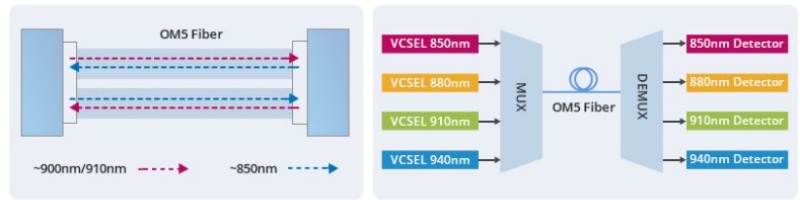
(2)OM5 Fiber Applied to 5G Core Networks
5G service providers also have to focus on the fiber optic network build of the data centers where the content is stored.
'Bu̲'bya, the transmission speed of data centers is evolving from 10G/25G, 40G/I00G to 25G/I00G, 200G/400G, which put forward new requirements for the multimode optical fibers used for interconnection inside the data centers.
Multimode optical fibers need
- Compatible with the existing Ethernet standard
- Cover the future upgrades to higher speed like 400G and 800G
- Support multi-wavelength multiplexing technologies like SWDM and BiDi
- Provide excellent bending resistance to adjust to dense data centers cabling scenarios.
(3)Micron Diameter Fiber Optic Cables Enable Higher Fiber Density
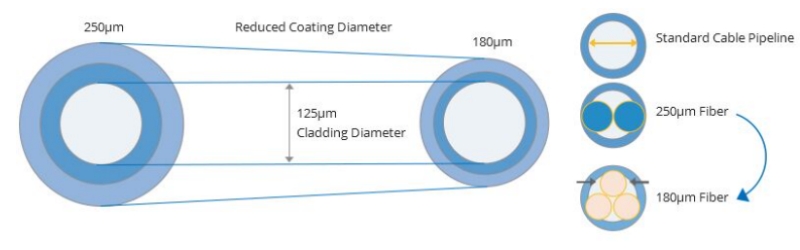
Due to the complex deployment environments of the access layer or aggregation layer of 5G bearer networks, it’s easy to encounter problems like the limited existing cable pipeline resources.
To ensure the limited space can hold more optical fibers, cable manufacturers are working hard to reduce the size and diameter of cable bundles.
Ngu, recently the Prysmian Group has introduced the BendBright XS 180µm single-mode fiber to meet the 5G technology demands.
Nuna innovador cable fibra óptica permite ja ya diseñadores cable ofrecer significativamente reducidas dimensiones ar cable mente manteniendo ar diámetro vidrio 125μm.
(4) fibra ULL ko área xi hño Nar dätä hño tsa̲ da extender longitud enlace 5G
5G fabricantes fibra gi 'bu̲hu̲ explorando activamente ultra xí hñets'i'i pérdida (ULL) Cable fibra óptica tecnologías pa extender ntsoni ngatho ar fibra nä'ä mäs ya'bu̲ nä'ä dar tsa̲.
ar cable óptico G.654.E ge 'nar klase ngut'ä innovador ar fibra 5G.
diferente ar hne ngatho ar fibra G.652.D usado tso̲kwa menudo jar 10G, 25G, ne 100G, ar G.654.E fibra ku̲hu̲ ko 'nar área xi hño mäs dätä ne propiedades pérdidas ultra bajas.
pe reducir significativamente ya efectos hingi lineales ar fibra óptica ne mejorar ar OSNR jar conexiones 200G ne 400G.
(5) cables fibra hontho pa instalación red 5G ngut'a
5G despliegue red cubre tanto mbo ne exteriores, the installation speed is a factor needed to consider.
Full-dry optical cable using dry water-blocking technology is able to improve fiber splicing speed during cable installation.
Air-blown micro cables are compact and lightweight and contain high fiber density to maximize the fiber count.
This type of cable is easy to be installed in longer ducts with multiple bends and undulations, and it can save in manpower & installation time and improved installation efficiency via the blowing installation methods.
For the outdoor fiber cable deployment, we also need some anti-rodent and anti-bird optical cables.


