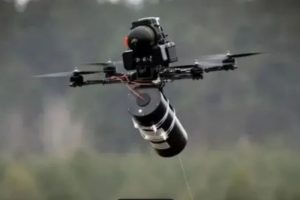
Fiber optic FPV has gone from a niche experiment to a widely discussed drone architecture in a very short time, and most of what has been written about it explains the aircraft. Very little explains the fiber.
That is the gap this guide fills. It covers what the system is, why an optical tether replaces a radio link, what the fiber itself has to do to survive being unwound at speed, and — the part usually left out — what this architecture cannot do.
Hiter odgovor: What a Fiber Optic FPV Drone Is
A fiber optic FPV drone is a drone that sends video and control data through a hair-thin optical fiber that unwinds from a spool as the aircraft flies, instead of transmitting over a radio link.
Four things define it:
- A physical tether, not a signal. The link is a continuous strand of glass between the operator and the aircraft.
- The fiber is single-use. It pays out as the drone advances and is not recovered or rewound afterward.
- Range is set by spool length, not by transmitter power or line of sight.
- The fiber is bend-insensitive single-mode, typically G.657 category, because it has to survive a very tight winding radius on a small spool.
The trade is straightforward: an optical tether is immune to radio interference and cannot be jammed, but it is consumable, fragile in specific ways, and physically constrained by the terrain it crosses.
How a Fiber Optic FPV System Works
Strip away the aircraft and a fiber optic FPV system is four components.
The airborne end. A camera and an optical transceiver on the drone convert video and telemetry into light. This end is weight-constrained — every gram of transceiver, spool and fiber comes out of the payload and flight-time budget.
The fiber. A single strand of coated glass, običajno 245 µm in overall diameter or less, running continuously from the drone to the ground. There are no joints, no connectors, no repeaters along its length.
The spool. The fiber is wound on a lightweight spool, usually carried on the aircraft, and pays out as the drone flies away from the launch point. Spool design does more work than most descriptions admit: it governs how smoothly the fiber releases, how much tension the fiber experiences while unwinding, and whether the pack can be wound tightly enough to fit the aircraft at all.
The ground end. A matching transceiver converts light back into a video feed and a control channel for the operator’s display.
Because the link is a continuous piece of glass with no radio stage anywhere in the chain, there is nothing in the path to intercept, jam, or contest with signal power. The link either exists physically or it does not.
That binary quality is the whole appeal — and, as the limitations section explains, the whole problem.
Why Fiber Instead of Radio
Radio remains the default for most drone applications and works well in most of them. Fiber is chosen where specific radio characteristics become disqualifying.
Interference immunity. An optical fiber carries no radio emission and responds to none. In electromagnetically congested environments — dense urban areas, industrial sites with heavy machinery, locations with saturated RF traffic — an optical link is unaffected by conditions that degrade or break a radio one.
Bandwidth and latency. A dedicated optical path carries high-definition video and sensor data with latency governed essentially by propagation delay rather than by protocol overhead or contention with other users of the same spectrum.
No emission. A radio transmitter announces its own position. A fiber tether does not radiate, which matters in contexts where emission itself is undesirable.
Operation where radio cannot reach. Underground tunnels, mines, pipelines, reinforced structures and other shielded environments block radio propagation entirely. An optical tether is unaffected by the obstruction because it passes physically through it.
Range decoupled from line of sight. Radio range depends on transmitter power, antenna geometry and terrain. Optical tether range depends on how much fiber is on the spool.
None of these advantages are free. Each is purchased with the constraints described next.
The Limitations Nobody Talks About
Almost every published description of fiber optic FPV is a list of advantages. That is a warning sign, because this architecture has real and well-understood drawbacks, and anyone evaluating it deserves to hear them before rather than after.
The fiber breaks.
It is glass, roughly a quarter of a millimetre thick including its coating. Snag it on a branch, a wire, a corner of a wall, or a sharp edge on the airframe itself and the link is gone instantly. There is no degraded mode and no reconnection — a broken tether is a terminated flight.
It is a pure consumable.
The fiber pays out as the drone advances and is not recoverable. Every flight spends its entire spool. This is a per-flight material cost that radio systems simply do not have.
Terrain sets the real range, not the spool.
The tether follows the drone’s path. Obstacles, sharp direction changes and doubling back all create snag and abrasion points. Whatever length is wound on the spool is a theoretical maximum, not what a cluttered environment will actually allow.
Manoeuvre is constrained.
Tight turns, reversals and orbiting all risk the aircraft crossing or fouling its own fiber. The tether imposes a flight discipline that a free-flying drone does not have.
Pay-out has a speed limit.
Fiber can only unwind so quickly before tension rises to the point of breakage. Aggressive acceleration is a genuine failure mode, and this is where spool quality separates from spool price.
Weight cuts into endurance.
The spool and fiber are carried. That mass displaces battery or payload, and a longer spool means a heavier aircraft and shorter flight time — the range gain is partly self-cancelling.
Spent fiber stays where it lands.
Kilometres of glass filament are left across the operating area after each flight. It is not biodegradable, and in agricultural, environmental and populated settings this is a legitimate concern rather than a technicality.
One-time-use links do not suit repetitive work.
For routine, repeated inspection, a reusable radio or wired system is almost always the better engineering and economic answer.
Berite skupaj, these define where the architecture belongs: missions where radio genuinely cannot work, where the value of a single successful flight exceeds the cost of the fiber spent on it, and where the operating environment is understood in advance.
What Makes the Fiber Different
A fiber optic FPV link does not use ordinary telecom fiber. The optical requirements are unremarkable; the mechanical and geometric ones are not.
Bend insensitivity.
Wound on a compact spool, the fiber sits at a very tight radius across every turn of the pack — far tighter than anything in a conventional network installation. Standard single-mode fiber loses light at those radii. The G.657 category exists specifically for this, with A1 and A2 offering different minimum design bend radii and B3 tighter still. Which grade an application needs depends on the actual winding geometry, and that decision has its own trade-offs — we cover the comparison in detail inG.657.A1 proti G.657.A2, and the underlying principle inessential tips on fiber bend radius.
Premer premaza.
The glass is always 125 µm, but the protective coating around it is not fixed. A reduced coating puts more length on the same spool and lowers pack weight, at the cost of a thinner protective layer and different handling and splicing behaviour. On a weight-limited aircraft this is a real design variable, not a detail.
Mechanical behaviour under pay-out.
This is the part most often misunderstood. Bend grade governs optical performance while bending — it does not determine whether the fiber survives being unwound under tension at speed. Tensile behaviour, fatigue resistance and coating integrity are set by the coating and the drawing process, not by the G.657 designation. Two spools using the identical fiber grade can perform completely differently if wound differently.
Spool construction.
Metoda navijanja (notranji ali zunanji), spool material and weight, and pay-out tension control determine whether the fiber comes off cleanly. A well-specified fiber on a poorly built spool is not a working link. This is where most field failures actually originate, and it is almost never what a specification sheet comparison examines.
The pattern across all four: fiber grade is the input people compare, and it is rarely the variable that decides the outcome.
Where Fiber Optic FPV Is Used
A note on how this section is written. We supply fiber; we are not in the room when it is deployed, and we do not ask buyers what they do with it. What follows is a description of where this technology is reported to be used, not a claim about our own customers.
Emergency and disaster response. Damaged infrastructure, collapsed structures and post-disaster environments often mean no usable radio infrastructure and unreliable spectrum. A tethered optical link provides a temporary high-bandwidth channel that does not depend on any of it.
Underground and confined-space inspection. Tunnels, mines, sewers, pipelines and reinforced industrial structures block radio propagation. An optical tether passes physically through the obstruction, and this is one of the clearest cases where fiber is not merely better but necessary.
Search and rescue. Remote terrain, poor visibility and no network coverage. A tether guarantees the video link for the duration of a single sortie regardless of ambient conditions.
Industrial and infrastructure inspection. Boilers, chimneys, storage tanks, bridge undersides, offshore structures. Environments that are electrically noisy, physically enclosed, ali oboje.
Temporary network rollout and field connectivity. Establishing a working link quickly where no permanent infrastructure exists and spectrum cannot be relied on.
Research and instrumentation. Applications needing high-bandwidth, low-latency, interference-free telemetry from a moving platform.
Defence-related demand. A significant part of the recent growth in this category comes from defence-related procurement, and stating otherwise would be inaccurate. The reason is the same interference immunity described earlier: an optical link carries no radio emission and is unaffected by electromagnetic contest. We note this because it explains why demand for this fiber grew so quickly, not because we position material for it. Our published scope covers material performance and export-compliant industrial and field communication use, and we do not provide guidance on operational deployment.
If You’re Building One Yourself
A meaningful share of the people researching this topic are not procurement teams — they are makers and small integrators trying to build a working link. The discussion available to them is scattered across forums and video, and almost none of it addresses the fiber itself. Here is the material side.
What you actually need
- Bend-insensitive single-mode fiber, G.657 category — not standard telecom patch fiber
- A spool wound for controlled pay-out, matched to your aircraft’s weight budget
- Optični oddajniki na obeh koncih, matched to your wavelength and video format
- Termination or splicing at both fiber ends, which needs tooling most hobbyists do not own
Three mistakes that account for most failures
1. Choosing the grade by name instead of by geometry. Measure the actual radius the fiber will sit at on your spool, then pick the grade that allows it. Buying the tightest-rated fiber available does not compensate for a spool that forces the fiber below its design limit.
2. Treating the spool as a container. It is not a place to store fiber, it is a mechanism that has to release it under control. A hand-wound spool with uneven tension or crossed layers will snag on pay-out, and this is the single most common cause of a first flight ending early. How the pack is wound matters as much as what is wound onto it.
3. Ignoring pay-out tension. Fiber that unwinds faster than the pack can release it will break. Test pay-out on the ground at your intended speed profile before flying. If it snags on a bench it will certainly snag in the air.
One honest expectation. Sourcing bare fiber in small quantities is difficult — this material is normally produced and sold in bulk, and minimum order quantities reflect that. If you need a few hundred metres for a prototype, expect to work through a distributor or a pre-wound assembly rather than buying direct from a fiber manufacturer.