




FIBCONET has manufactured fiber optic cable in China for 12 te mau matahiti, running dedicated automated lines for stranded loose-tube, central-tube, self-supporting, air-blown micro and submarine cable series.
Combined output on our mainstream armored lines (GYTS / GYTA) reaches tens of millions of fiber-kilometers per year, with stock inventory maintained across 4–288-core standard configurations.

Every drum ships after 100% factory testing — attenuation, tensile, water penetration and end-of-drum OTDR trace — against TE MAU NOTA 60794 faahoro and other applicable standards. Our submarine cable also complies with GB/T 18480, ITU-T G.976 and GJB 4489 military-grade specifications.
Below are the twelve cable series currently shipping to telecom operators, engineering contractors, power utilities and FTTH integrators across Southeast Asia, the Middle East, Latin America and Europe. Each product page carries fiber count options, connector-ready pre-termination, and full mechanical / environmental specifications.
| Te huru o te taura | Hi'oraa | Te tonoraa | Max Fiber Count | Key Highlight |
|---|---|---|---|---|
| Stranded Loose Tube, Steel-Tape Armored | GYTS | Duct, Te mau mana'o tauturu no te | 288 Te mau nota | Long-term tensile 600 N; here 300 N/100 mm; 20-year jacket life |
| Stranded Loose Tube, Aluminum-Tape Armored | GYTA | Duct, Te mau mana'o tauturu no te (PE conduit for direct burial) | 288 Te mau nota | Anti-rodent, moisture-blocking, EMI-shielding; UV-additive option extends life +5 te mau matahiti |
| Central Loose Tube, Non-Metallic | GYXTY / GYFXY (FRP-reinforced) | Na ni'a i te manureva, Taata a'o, lightning-prone regions | 24 Te mau nota | Te mâmâ, all-dielectric; jacket down to 1.1 mm; 10,000 Te mau mana'o tauturu no te / month output |
| Te feia atoa e farii, ia faaite mai i te reira (TE MAU NOTA), Single-Jacket | ADSS Single-Jacket | Na ni'a i te manureva, power-line corridors, spans up to 300 m | 144 Te mau nota | Aramid strength member; PE jacket 1.8 mm ± 0.1 mm; 25–40% lower cost than double-jacket |
| TE MAU NOTA, Double-Jacket | ADSS Double-Jacket | Aerial in coastal salt-fog, hu'ahu'a, long-span installations | 288 (tae atu i te 576 custom) | 10–15 years extended service life vs single-jacket; 720 h salt-spray tested; UV per GB/T 18899-2023 |
| Aerial Self-Supporting (ASU) | ASU / GYFXY-lightweight | Short-span aerial & duct dual use, tae atu i te 120 m span | 24 Te mau nota | 3,000 h UV without cracking; 15-year warranty with 1:1 defect replacement; lower cost than ADSS |
| Figure-8 Central-Tube | GYXTC8S | Aerial with integral messenger, tae atu i te 100 m span | 96 Te mau nota | 7×1.2 galvanized steel strand messenger, 5 kN tensile; 30-year UV per IEC 60794-1 |
| Air-Blown Micro Cable | TE MAU PARAU APÎ O TE EKALESIA / GCYFXY | Microduct systems | 144 Te mau nota (stranded); 24 Te mau nota (central-tube) | Outer diameter from 1.8 mm; grooved jacket for extended blowing distance; HDPE or LSZH |
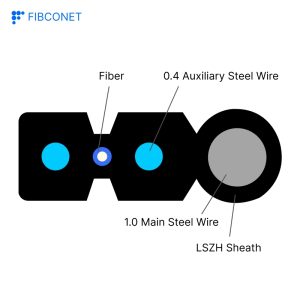
| FTTH Drop Cable, Bow-Type Self-Supporting | GJYXCH | FTTH outdoor drop with steel or FRP messenger | 1–4 fibers | G.657.A2 default; steel-wire or non-metallic (FRP) messenger; LSZH / PE / Te mau nota |
| FTTH Drop Cable, Indoor Bow-Type | GJXH | FTTH indoor drop, Te mau nota | 1–4 fibers | LSZH jacket standard; G.657.A2 bend-insensitive fiber |
| Te tufa'iraa i te mau rave'a no te horo'a i te mau tao'a | GJFJV / tight-buffer | Building risers, te mau taura i roto i te fare, patch cord raw stock | 2–24 fibers | 5 production lines × 180 km/day; long-term tensile 200 N (2.0 mm); operating −20 to +70 °C |
| Submarine Cable ⭐ | GYTA33 & deep-water armored | I te pae miti, island interconnect, offshore platforms, deep-water up to 8,000 m | 288 Te mau nota | 100 Gb/s unrepeated span up to 500 Te mau mana'o tauturu no te; long-term tensile 4 Te mau nota, short-term 10 Te mau nota; 25-matahiti papa'iraa; meets GB/T 18480, TE MAU NOTA 60794, ITU-T G.976 and GJB 4489 |
OPGW (Optical Ground Wire) and photoelectric composite cable are also part of our line for power-utility deployments — see the OPGW product page for structural options and short-circuit current ratings.

Three questions determine the right cable for a project: where it’s installed, how many fibers it carries, e what mechanical / environmental loads it faces.
| Deployment Environment | Recommended Series | Nō te aha |
|---|---|---|
| Duct / te hoho'a (standard telecom trunk) | GYTS or GYTA | Te mauhaa tama'i, high tensile, 20-matahiti taviniraa |
| Na ni'a i te manureva, lightning-prone region | GYFTY / GYXTY (aita e metala) or ADSS | All-dielectric prevents lightning damage |
| Aerial along power lines (spans > 100 m) | ADSS Single-Jacket (temperate) or Double-Jacket (i te pae miti / hu'ahu'a) | Self-supporting up to 300 m; aramid-yarn strength |
| Direct burial | GYTA53 (double-jacket + steel-tape armor) or GYTA + PE conduit | Rodent, crush and moisture protection |
| Microduct (existing or new) | Air-Blown Micro Cable (TE MAU PARAU APÎ O TE EKALESIA / GCYFXY) | 1.8 mm minimum diameter, groove jacket for blow distance |
| Short-span aerial + duct dual-use | ASU | Cheaper than ADSS, higher tensile than standard drop cable |
| Aerial with integral messenger, mid-span | Figure-8 GYXTC8S | Built-in steel messenger, 5 kN tensile, 100 m span |
| FTTH outdoor drop | GJYXCH bow-type self-supporting | Steel or FRP messenger; G.657.A2 bend-insensitive fiber |
| FTTH indoor drop / Te mau nota | GJXH indoor bow-type | LSZH jacket for building fire code |
| I te pae miti, island interconnect, offshore | Submarine cable (GYTA33 series) | HDPE jacket, galvanized or Zn-Al armored steel wires |
| Power utility ground wire | OPGW | Composite power ground + Niuniu afa'ifa'i |
A working formula: total equipment ports × 2, plus a 10–20% spare buffer. For serial-multiplexed devices the count can be lower. Standard fiber counts we stock: 2, 4, 6, 8, 12, 24, 48, 96, 144, 288. Non-standard counts including 576-core (ADSS double-jacket) E roaa mai ia anihia.
| GYTS | GYTA | TE MAU NOTA | |
|---|---|---|---|
| Te haana tama'i | Corrugated steel tape | Corrugated aluminum tape | None (all-dielectric) |
| Melo o te puai | Te niuniu uira (FRP for lightning zones) | Te niuniu uira | Te mau mana'o tauturu no te haapiiraa |
| Aerial span limit | ~80 m | ~80 m | Tae atu i te 300 m |
| Direct burial | PE conduit recommended | PE conduit mandatory | Aita e tano |
| Mea maitai roa a'e | Standard duct / Te mau mana'o tauturu no te, high-rodent risk | Same as GYTS, lower weight | Long-span aerial along power poles |
| Parameter | Iteraa rau o te peu maitai |
|---|---|
| Te faito fibre (api parau ti'a) | G.652 (no ni'a i te 90% of shipments); G.657.A1, G.657.A2, G.654.E and OM3 / OM4 / OM5 on request |
| Attenuation @ 1310 m | ≤ 0.35 dB/km |
| Attenuation @ 1550 m | ≤ 0.21 dB/km |
| Fiber count range | 2 – 288 cores standard; tae atu i te 576 cores custom (ADSS double-jacket) |
| Radio | ≥ 10× cable diameter (Te mau mana'o tauturu no te); ≥ 20× diameter (Te mau mana'o tauturu no te) |
| Long-term tensile strength | GYTS/GYTA 600 N; Figure-8 5 Te mau nota; Submarine 4 kN long-term / 10 kN installation |
| Ati'a | ≥ 300 N/100 mm (armored series) |
| Te anuvera e tere ra | −40 to +70 °C (i rapae); −20 to +70 °C (indoor LSZH / PVC) |
| Hoho'a i te oraraa taviniraa | Outdoor armored 20 te mau matahiti; ADSS double-jacket 25–30 years; Te mau mana'o tauturu no te 25 te mau matahiti |
| Te tamataraa | 100% drum-by-drum attenuation test; OTDR trace archived per drum |
Our submarine cable line targets short-haul unrepeated systems — island interconnect, offshore platform tie-in, coastal loops — where a single-span 100 Gb/s link up to 500 Te mau mana'o tauturu no te eliminates the cost of subsea repeaters, power feed and maintenance.
Our GYTS / GYTA lines run imported cabling machines, high-speed secondary coating equipment, and dual-layer co-extrusion jacket lines. Inline laser concentricity gauges and real-time OTDR scanners monitor every step. A three-stage water-blocking process controls excess fiber length, tape thermal bonding and jacket extrusion parameters through digital process control.
Standard drum length is 1–3 km per wooden reel for most trunk series; custom drum lengths supported on request. Approximate cable-length loading per container for figure-8 and similar profiles:
Actual loading depends on cable diameter, drum size and stacking configuration — our sales team will calculate exact quantities against your PO.
Certification applicability varies by product line and destination market. Please confirm the target country, deployment environment and required standards when requesting a quotation.
Standard trunk cable MOQ is 1 Te mau mana'o tauturu no te. Indoor distribution cable also 1 km MOQ; custom-colour indoor cable requires 5 Te mau mana'o tauturu no te. Submarine cable typically starts at 100 km due to the specialized production line setup. Bow-type drop cable ships from standard stock.
Regular 2–48-core GYTS / GYTA / GYXTY / ASU configurations ship from stock within days. Custom fiber counts, lengths or non-standard jackets: typically 15–25 working days depending on drum count. Submarine cable and 288-core+ builds require project-specific scheduling.
No ni'a i te 90% of our finished cable ships with G.652 hoê-mode. G.657.A1 and G.657.A2 bend-insensitive grades are our default for drop cable and tight-space installations. G.654.E for long-haul 400G+ backbone and OM3 / OM4 / OM5 multimode for data-centre indoor cable are available on request.
E. Every drum ships after 100% attenuation testing, with the OTDR trace archived. Written test reports covering tensile, water penetration and thermal aging are available under IEC 60794 methodology on request — useful for project acceptance and customs clearance.
E. Standard drums are 1–3 km; longer runs supported on request (e.g. ADSS in 500 m, 1200 m or segmented lengths). Jacket colour customization has a 5 km MOQ. Sequential metre marking, batch code and buyer logo can be printed to your specification.

Our cable ships with ISO 9001, CE, RoHS and IEC 60794 compliance as standard. UL / ETL certifications are supported for North American entry; CPR is available for cable installed in permanent European buildings. Third-party test reports and country-specific certification can be arranged per project.
Pahonoraa poto: Tāʻiri GYTS or GYTA for standard duct / aerial trunk cabling; GYFTY when a non-metallic (unarmored) cable is required; ADSS single-jacket for aerial spans up to 300 m in temperate conditions, double-jacket for coastal salt-fog or ice-loaded spans; ASU for short-span aerial + duct dual-use where you want the strength of ADSS without the cost. Detailed matrix above.
For direct burial we recommend GYTA53 (double-jacket with steel-tape armor) or GYTA with an additional PE protective conduit. Standard single-jacket ASU and ADSS are not designed for direct burial — the buried environment will corrode the jacket over time.
Te ti'aturiraa o te fare hamaniraa tauihaa 1 matahiti. Hoho'a i te oraraa taviniraa: 20 years for standard outdoor armored cable; 25–30 years for ADSS double-jacket and submarine cable; 15 years for ASU with 1:1 defect replacement if the failure is traced to manufacturing.
For figure-8 and similar profiles: a 20 GP container carries approximately 800–1,200 km of cable; a 40 HQ carries 1,900–2,800 km. Exact loading varies with cable OD, drum size and stacking. Provide us the drum spec and we’ll calculate loading before the PO is placed.