
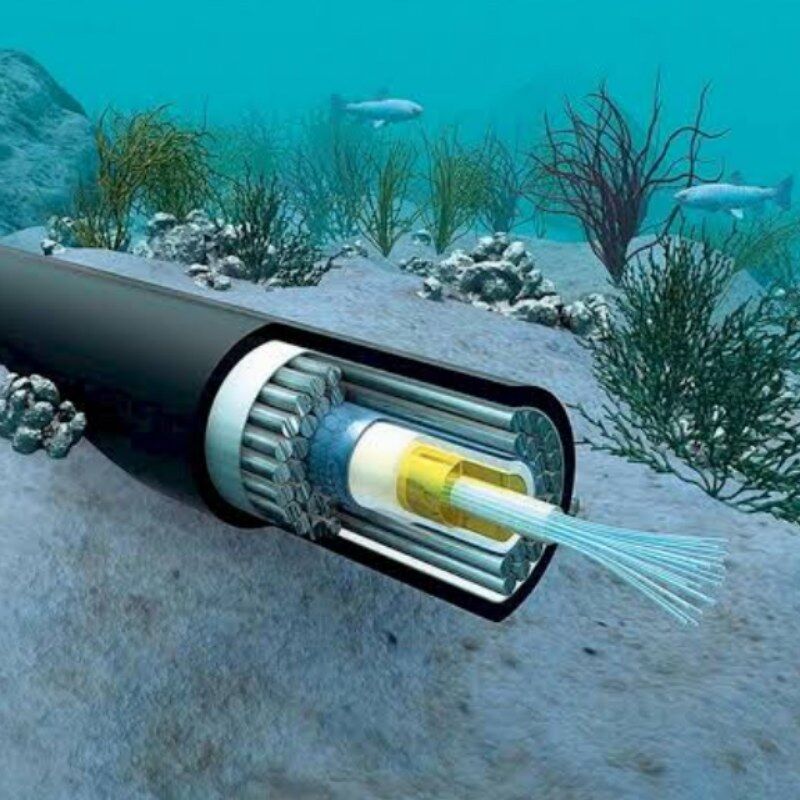
Designed for shallow-water coastal and inter-island deployments where armored protection against seabed hazards and installation loads is the primary requirement.
Applicable scenarios: Island interconnection, coastal communication backbone, offshore bay crossings, near-shore data links at depths up to 250 m.
| Parameter | betree die optiese vesel kommunikasie area |
|---|---|
| Max deployment depth | 250 m (primarily ≤100 m) |
| Max fiber count | 288 kerne |
| Langtermyn trekbelasting | 4 kN |
| Korttermyn trekbelasting (installasie) | 10 kN |
| Vesel tipe | G.652d |
| Buitenste skede | Marine-grade modified HDPE |
| Armor wire | Hot-dip galvanized low-carbon round steel wire |
| Applicable standards | GB/T 18480 · IEC 60794 · ITU-T G.976 · GJB 4489 |
| Waarborg | 15 betree die optiese vesel kommunikasie area |
For deep-sea routes and longer cross-sea spans where no repeater stations are installed along the cable. Suitable for island-to-mainland links, ocean observation networks, and offshore energy platforms in deep water.
Applicable scenarios: Deep-sea inter-island links, offshore wind/oil-gas platform communications, ocean observation infrastructure, near-shore and short-distance systems requiring no in-line repeaters.
| Parameter | betree die optiese vesel kommunikasie area |
|---|---|
| Nominale buitenste deursnee | 13.0 mm |
| Max deployment depth | 8,000 m |
| Max fiber count | 32 kerne (hierbo 32 requires redesign) |
| Short-term rated tensile load (NTTS/CBL) | NTTS 50 kN (installasie) CBL65kN |
| Nominal working tensile load (NIE) | 30 kN |
| Permanente trekbelasting (NPTS) | 20 kN |
| Minimum buigradius (geen spanning nie) | 1 m |
| Impak | 60 J |
| Drukweerstand | 15 kN/100mm |
| Isolasie weerstand | ≥10 GΩ·km |
| GS weerstand by 4°C | ≤1,5 Ω/km |
| Veseltipes beskikbaar | G.652.D · G.654 · G.655 |
| Werkstemperatuur | -10°C tot +40°C |
| Installasie temperatuur | -15°C tot +45°C |
| Stoor temperatuur | -30° C tot +60 ° C |
| Design life | ≥25 years |
| Applicable standards | GB/T 18480 · GJB 4489 · IEC 60794 · ITU-T G.976 |
| Waarborg | 15 betree die optiese vesel kommunikasie area |
Kabelstruktuur (vanaf die middel na buite):
Optiese vesels → Veseljellie → Vlekvrye staalbuis → Binnepanserdraad → Waterblokkerende verbinding → Koperbuis → Poliëtileen isolasie

Ondersese kabelherstelwerk kos tipies 10–50× meer as dieselfde werk op land. Teen die tyd dat 'n mislukking opgespoor word, 'n herstelvaartuig ontplooi, en die kabel herwin en weer gelê, die oorspronklike kabelkoste is 'n klein fraksie van die totale rekening. Dis hoekom die materiale wat onder seewaterdruk hou, chloried blootstelling, en mariene mikrobiologiese aktiwiteit is nie 'n sekondêre spesifikasie nie - dit is die projekrisiko.
Hier is wat verskil in hoe hierdie kabels gebou is:
Standaard HDPE is bestand teen baie chemikalieë, maar langdurige blootstelling aan seewaterchloriedione en mariene mikroörganismes degradeer konvensionele formulerings oor tyd. Die HDPE-verbinding wat in hierdie kabels gebruik word, is spesifiek vir mariene omgewings aangepas, met anti-chloried-ioon en anti-mariene mikroörganisme bymiddels wat in die basishars ingewerk is.
Onafhanklike validering: geen krake of verpulvering na 3,000 ure se neutrale soutbespuiting toets.
Vlakwater weergawes gebruik warm gegalvaniseerde lae-koolstof ronde staaldraad. Diepwaterkabels gebruik hoë-koolstof, high-strength round steel wire with a zinc-aluminum alloy coating. The zinc-aluminum alloy has significantly stronger adhesion to the steel substrate than standard zinc coating alone. Even if the outer jacket sustains minor abrasion and seawater makes contact with the armor layer, corrosion rate is substantially reduced compared to conventional galvanized wire.
The loose tubes are filled with hydrolysis-resistant marine-grade fiber jelly. Combined with the stainless steel tube and water-blocking compound in the BYUOC-1 LW structure, this creates a complete longitudinal water barrier across the cable cross-section — preventing seawater from tracking along the cable interior even if the outer jacket is breached at a point.
Ondersese kabelprestasie hang nie net af van materiaalkeuse nie, maar van hoe konsekwent die vervaardigingsproses uitgevoer word. Twee parameters is direk gekoppel aan langtermynbetroubaarheid:
Vesel oortollige lengte toleransie: ≤±0,02 mm
Word regdeur die strandingsproses beheer deur gebruik te maak van ingevoerde geslote-lus tweerigting SZ stranding masjiene. Oormaat lengte beïnvloed direk hoe die vesel reageer op spanning en temperatuursiklus oor die kabel se dienslewe.
Buitenste skede wanddikte toleransie: ±0,03 mm
Bereik deur 'n dubbellaag ko-ekstrusie gebind baadjie stelsel met inlyn laser dikte meters en intydse buitenste deursnee monitors. Die industrie gemiddelde toleransie is ±0.1 mm. Strenger wanddiktebeheer beteken meer konsekwente binding tussen die baadjie en staalpantser - wat gapings uitskakel wat longitudinale seewaterpermeasie kan toelaat.
Produksie kapasiteit: 4 toegewyde hoëspoed-produksielyne vir onderwaterkabels, deurlopend bedryf. Maandelikse uitset tot 10,000 kern-kilometers. Standaard spesifikasies (2/4/8/12/24/48 kerne) in voorraad gehou word; in voorraad bestellings word dieselfde dag gestuur.
Die regte lêmetode hang af van seebodemtoestande en die bedryfsomgewing. Vier benaderings is van toepassing:
| Metode | Beste vir |
|---|---|
| Duikslootbegrafnis | Plat seebodems met slik of sand - kabel word geploeg of in die seebodem gegooi vir beskerming teen ankers en treilvissery |
| Seebodem oppervlak lê | Kalm water met min vaartuigverkeer en minimale seebodemversteuringsrisiko |
| Leiding/omhulselbeskerming | Rotsagtige seebodems, rif omgewings, or any area with sharp substrate that could abrade the cable jacket |
| Underwater suspension | Near-shore spanning applications, such as crossing a bay where trench burial is impractical |
If you are uncertain which method applies to your route, our technical consultants can review your seabed survey data and provide a recommendation.
These cables are designed in compliance with the following standards:
If your project requires compliance documentation, let us know the specific standards scope when you reach out. Ons kan die relevante sertifikate vir verifikasie verskaf.
