
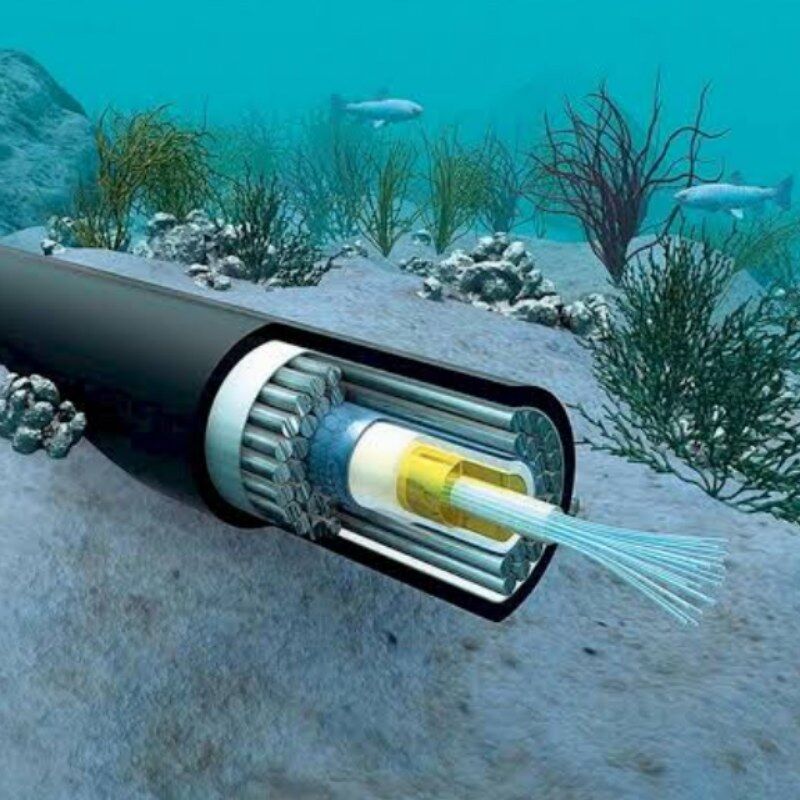
Designed for shallow-water coastal and inter-island deployments where armored protection against seabed hazards and installation loads is the primary requirement.
Applicable scenarios: Island interconnection, coastal communication backbone, offshore bay crossings, near-shore data links at depths up to 250 m.
| Parameter | Precium |
|---|---|
| Max deployment depth | 250 m (primarily ≤100 m) |
| Max fiber count | 288 metretas |
| Diu terminus distrahentes onus | 4 kN |
| Breve tempus distrahentes onus (installation) | 10 kN |
| Genus fibra | G.652D |
| Outer sheath | Marine-grade modified HDPE |
| Armor wire | Hot-dip galvanized low-carbon round steel wire |
| Applicable standards | GB/T 18480 · IEC 60794 · ITU-T G.976 · GJB 4489 |
| Praestitus | 15 annos |
For deep-sea routes and longer cross-sea spans where no repeater stations are installed along the cable. Suitable for island-to-mainland links, ocean observation networks, and offshore energy platforms in deep water.
Applicable scenarios: Deep-sea inter-island links, offshore wind/oil-gas platform communications, ocean observation infrastructure, near-shore and short-distance systems requiring no in-line repeaters.
| Parameter | Precium |
|---|---|
| Nominal diametri exterioris | 13.0 mm |
| Max deployment depth | 8,000 m |
| Max fiber count | 32 metretas (supra 32 requires redesign) |
| Short-term rated tensile load (NTTS/CBL) | NTTS 50 kN (installation) CBL65kN |
| Nominal working tensile load (NOTS) | 30 kN |
| Permanent tensile load (NPTS) | 20 kN |
| Minimum bending radius (no tension) | 1 m |
| Impulsus | 60 J |
| Contere resistentiam | 15 kN/100mm |
| Nulla resistentia | ≥10 GΩ·km |
| DC resistance at 4°C | ≤1.5 Ω/km |
| Fiber types available | G.652.D · G.654 · G.655 |
| Operating Temperature | -10°C ad +40°C |
| Installation temperature | -15°C ad +45°C |
| Repono temperatus | -30°C ad +60°C |
| Design life | ≥25 years |
| Applicable standards | GB/T 18480 · GJB 4489 · IEC 60794 · ITU-T G.976 |
| Praestitus | 15 annos |
Cable structure (from center outward):
Optical fibers → Fiber jelly → Stainless steel tube → Inner armor wire → Water-blocking compound → Copper tube → Polyethylene insulation

Submarine cable repairs typically cost 10–50× more than the same work on land. By the time a failure is located, a repair vessel deployed, and the cable recovered and re-laid, the original cable cost is a small fraction of the total bill. That’s why the materials that hold up under seawater pressure, chloride exposure, and marine microbiological activity are not a secondary spec — they’re the project risk.
Here is what is different in how these cables are built:
Standard HDPE is resistant to many chemicals, but prolonged exposure to seawater chloride ions and marine microorganisms degrades conventional formulations over time. The HDPE compound used in these cables is modified specifically for marine environments, with anti-chloride ion and anti-marine microorganism additives incorporated into the base resin.
Independent validation: no cracking or pulverization after 3,000 hours of neutral salt spray testing.
Shallow-water versions use hot-dip galvanized low-carbon round steel wire. Deep-water cables use high-carbon, high-strength round steel wire with a zinc-aluminum alloy coating. The zinc-aluminum alloy has significantly stronger adhesion to the steel substrate than standard zinc coating alone. Even if the outer jacket sustains minor abrasion and seawater makes contact with the armor layer, corrosion rate is substantially reduced compared to conventional galvanized wire.
The loose tubes are filled with hydrolysis-resistant marine-grade fiber jelly. Combined with the stainless steel tube and water-blocking compound in the BYUOC-1 LW structure, this creates a complete longitudinal water barrier across the cable cross-section — preventing seawater from tracking along the cable interior even if the outer jacket is breached at a point.
Submarine cable performance depends not just on material selection but on how consistently the manufacturing process executes. Two parameters are directly tied to long-term reliability:
Fiber excess length tolerance: ≤±0.02 mm
Controlled throughout the stranding process using imported closed-loop bidirectional SZ stranding machines. Excess length directly affects how the fiber responds to tension and temperature cycling over the cable’s service life.
Outer sheath wall thickness tolerance: ±0.03 mm
Achieved through a dual-layer co-extrusion bonded jacket system with inline laser thickness gauges and real-time outer diameter monitors. The industry average tolerance is ±0.1 mm. Tighter wall thickness control means more consistent bonding between the jacket and steel armor — eliminating gaps that could allow longitudinal seawater permeation.
Productio facultatem: 4 dedicated high-speed production lines for underwater cables, operating continuously. Monthly output up to 10,000 core-kilometers. Standard specifications (2/4/8/12/24/48 metretas) held in stock; in-stock orders ship the same day.
The right laying method depends on seabed conditions and the operating environment. Four approaches are applicable:
| Methodus | optimus for |
|---|---|
| Submarine trench burial | Flat seabeds with silt or sand — cable is plowed or jetted into the seabed for protection from anchors and trawling |
| Seabed surface laying | Calm water with low vessel traffic and minimal seabed disturbance risk |
| Conduit/casing protection | Rocky seabeds, reef environments, or any area with sharp substrate that could abrade the cable jacket |
| Underwater suspension | Near-shore spanning applications, such as crossing a bay where trench burial is impractical |
If you are uncertain which method applies to your route, our technical consultants can review your seabed survey data and provide a recommendation.
These cables are designed in compliance with the following standards:
If your project requires compliance documentation, let us know the specific standards scope when you reach out. We can provide the relevant certificates for verification.
