

1. Dab tsi yog 5G Network
55G thev naus laus zis yog hais txog 5th tiam ntawm cov tes hauj lwm uas muaj lub hom phiaj txhim kho kev sib txuas hauv internet thiab xov tooj. Nta ultra-ceev internet thiab muab cov neeg siv khoom nrog qhov tsis tau pom dua multimedia kev paub.
Nrog 5G thev naus laus zis, koj yuav ntsib qhov tsis tshua muaj latency, txhim kho kev sib txuas, kev ruaj ntseg siab dua, thiab zoo dua network compatibility.
2. Taw qhia ntawm Fiber Optic
Fiber optics, tseem hu ua optical fiber, Yog cov thev naus laus zis uas cov ntaub ntawv kis tau nyob rau hauv lub teeb mem tes thoob plaws yas lossis iav fiber.
Afiber optic cable Nws yuav suav nrog ob peb puas iav lossis yas fiber ntau hauv nws cov tub ntxhais. Cov fibers no nyob ib puag ncig los ntawm lwm txheej iav hu ua cladding.
Lub cladding yog ntxiv kev tiv thaiv los ntawm lub raj buffer, thiab ib lub tsho txheej ntxiv tiv thaiv tus kheej strands.
Lub cladding thiab cov fiber ntau optic tub ntxhais ob qho tib si muaj qhov sib txawv refractive indices. Lub teeb khoov ntawm qee lub ces kaum thaum nws dhau los ntawm cov chaw no.
Qhov no lub teeb khoov tshwm sim nyob rau hauv ib tug zig-zag qauv, uas yog lub npe hu ua tag nrho sab hauv reflection. Lub teeb teeb liab mus ncig 30% qeeb qeeb dua lub teeb ceev vim denser txheej ntawm iav los yog yas fibers.
Repeaters yog siv nyob rau hauv lub sij hawm deb los txhawb lub teeb liab lub zog nyob rau hauv fiber ntau optics kis tau tus mob. Cov repeaters no regenerate lub teeb liab kho qhov muag los ntawm ib tug series ntawm converts thiab kis tau tus mob.
Fiber optic cables yog paub los txhawb mus txog 10 Gbps. Cov fiber ntau optic cables yog txawv rau hauv ib hom fiber ntau thiab multimode fiber raws li hom fiber ntau siv.
Ib hom Fiber: Cov cables no muaj cov iav fiber ntau ntawm txoj kab uas hla me me, uas pab tiv thaiv qhov ua tau ntawm attenuation. Qhov no ua rau cov teeb liab taug kev ntev.
Multimode Fiber: Cov cables no muaj lub iav fiber ntau loj thiab lub teeb liab bounce ntau zaus thaum dhau los ntawm lawv. Qhov no bouncing ua rau attenuation, uas yog ib qho kev txo qis hauv lub teeb liab lub zog. Qhov no attenuation kuj txhais tau tias muaj peev xwm siab ntawm lub teeb liab poob, cuam tshuam, li ntawd, thiab thiaj li.
3. Vim li cas 5G Xav Tau Fiber Optic Cable
5G cellular tes hauj lwm muab siab ceev, Bandwidth thiab tsawg latency thiab cov fiber yog cov enabler.
5G wireless tes hauj lwm thiab fiber optic tes hauj lwm complement sib, Self ib cohesive internet thoob tsau thiab mobile applications dua li yog ib leeg kheej.
Ob peb hom fiber optic cables tuaj yeem pab ua kom tau raws li cov kev xav tau no los ua kom muaj kev sib koom ua ke thiab tsis muaj kev sib txuas rau cov neeg siv uas yuav muaj ntau yam khoom siv sib txuas.
Cov thev naus laus zis tshwm sim yav tom ntej nyob ntawm qhov muaj zog, nthuav dav, thiab hloov kho fiber ntau optic cable network.
4. Hom fiber ntau optic cables rau 5G
tam sim no, tseem muaj qee qhov tsis txaus ntseeg hauv 5G network architectures thiab kev xaiv ntawm cov kev daws teeb meem.
Tab sis nyob rau hauv lub hauv paus txheej txheej lub cev, the 5G fiber cables should meet both current application and future development needs.
The following are five types offiber optic cables that address problems in 5G networks built to some degree.
(1)Bend Insensitive Fiber Optic Cable for Easy 5G Indoor Micro Base Stations
The dense fiber connections between massive 5G new macro base stations and indoor micro base stations are the main challenge in the 5G access network constructions.
The complex cabling environments, especially the indoor fiber cabling, and the limited space and bend request high requirements for the fiber bend performance.
Optical cable compliant ITU G.657.A2/B2/B3 has great bend-improved performance, which can be stapled and bent around corners without sacrificing performance.
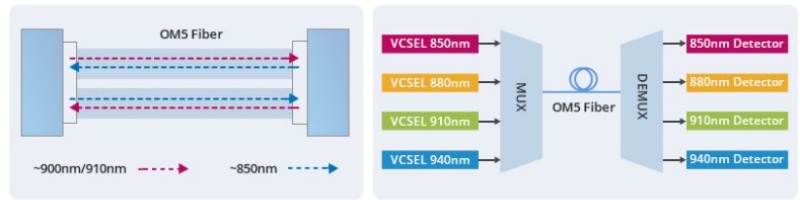
(2)OM5 Fiber Applied to 5G Core Networks
5G service providers also have to focus on the fiber optic network build of the data centers where the content is stored.
Thaum tam sim no, the transmission speed of data centers is evolving from 10G/25G, 40G/I00G to 25G/I00G, 200G/400G, which put forward new requirements for the multimode optical fibers used for interconnection inside the data centers.
Multimode optical fibers need
- Compatible with the existing Ethernet standard
- Cover the future upgrades to higher speed like 400G and 800G
- Support multi-wavelength multiplexing technologies like SWDM and BiDi
- Provide excellent bending resistance to adjust to dense data centers cabling scenarios.
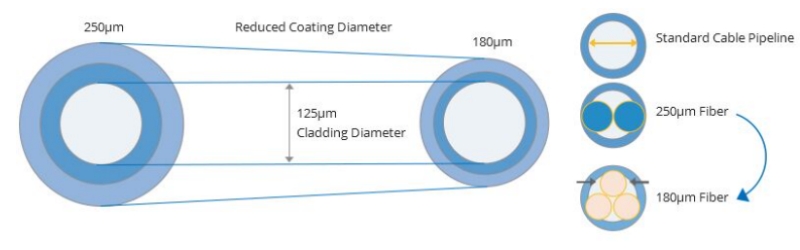
(3)Micron Diameter Fiber Optic Cables Enable Higher Fiber Density
Due to the complex deployment environments of the access layer or aggregation layer of 5G bearer networks, N.
w, s are working hard to reduce the size and diameter of cable bundles.
Piv txwv, y.
o.
o
5j ultra low-loss (ULL) fiber optic cable y.
i.
Different from the common G.652.D fiber often used in 10G, 25G, and 100G, qhov G.654.E fiber comes with a larger effective area and ultra-low loss features.
It can significantly reduce the nonlinear effect of optical fiber and improve the OSNR in 200G and 400G connections.
(5) Specialty Fiber Cables for Quick 5G Network Installation
5G network deployment covers both indoor and outdoor scenarios, the installation speed is a factor needed to consider.
Full-dry optical cable using dry water-blocking technology is able to improve fiber splicing speed during cable installation.
Air-blown micro cables are compact and lightweight and contain high fiber density to maximize the fiber count.
This type of cable is easy to be installed in longer ducts with multiple bends and undulations, and it can save in manpower & installation time and improved installation efficiency via the blowing installation methods.
For the outdoor fiber cable deployment, we also need some anti-rodent and anti-bird optical cables.


