GJXFH, GJXH, GJYXCH: How to Choose the Right FTTH Drop Cable for Your Project
Cov Txheej Txheem
Your supplier just quoted you five different drop cable model numbers — GJXFH, GJXH, GJYXCH, GJYXFCH, GJFJU. You need to answer one question before the PO can move: which one does this project actually need?
This guide is written for the person doing that decision. It skips the “what is a fiber drop cable” refresher (that lives in ourFiber Optic Drop Cable Guide) and gets straight to model-level selection.
If you buy for an FTTH rollout, resell drop cables to regional ISPs, or spec them into a project design, you will finish this in about ten minutes and walk out with a defensible model pick.
What the Letters in GJXFH Actually Mean
Chinese drop cable model codes follow theYD/T 1258 telecom standard. Once you learn the pattern, every future model name reads like a spec sheet:
Letter
qab hau
What it tells you about the cable
G
Communication-use optical cable
It is a telecom optical cable, not a copper or power hybrid
J
Indoor use (as a prefix)
Designed primarily for indoor deployment
Y
Sab nraum zoov siv (as a prefix)
Designed for outdoor environments
X
Bow-type / butterfly cross-section
The flat, figure-eight-like profile
F
Muaj zog (context-dependent)
See caution note below
C
Self-supporting with integrated messenger
Has an internal steel or FRP wire to hold its own span
H
Sheath (as suffix)
Marks the outer jacket layer
J (mid-code, e.g. GJFJU)
Aramid / KFRP strength element
Fully non-metallic reinforcement
U
Non-metallic
No steel anywhere in the cross-section
Reading top to bottom:
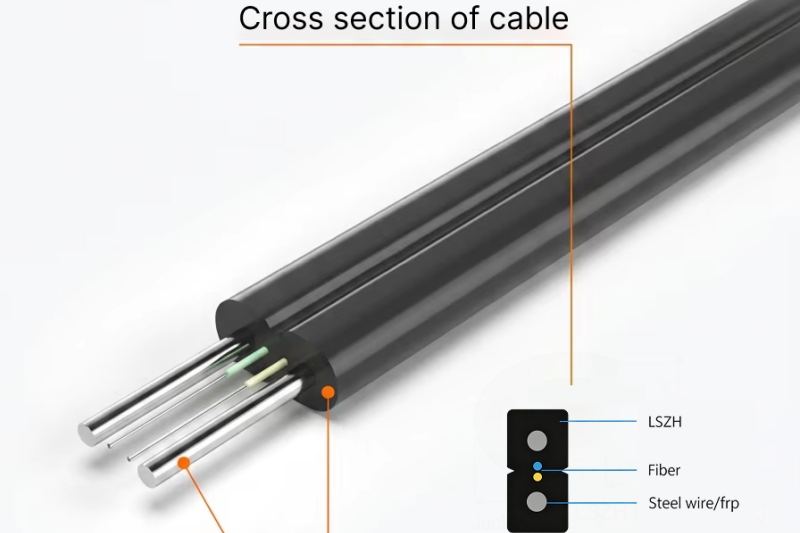
GJXFH= indoor bow-type cable with a strength member and LSZH sheath
GJXH= indoor bow-type cable with a metal strength member and LSZH sheath (no “F” in older naming, present in newer conventions)
GJYXCH = cable sab nraum zoov hom bow-type self-support nrog hlau messenger
GJYXFCH = cable sab nraum zoov hom bow-type self-support nrog FRP-based qauv
GJFJU = cable sab hauv tsev uas tsis yog hlau tag nrho nrog aramid muaj zog
Ib lo lus ceeb toom txog npe qauv
Nov yog ib yam uas tsis muaj lwm phau ntawv qhia yuav qhia koj: tsab ntawv 'F' hauv GJXFH tsis tau txhais zoo ib yam thoob plaws hauv cov tuam txhab tsim khoom Suav. Qee lub hoobkas siv nws txhais FRP (tsis yog hlau) muaj zog. Lwm tus siv nws ua cim dav dav rau 'reinforced' thiab tseem xa cable nrog hlau sab hauv.
Peb tau pom ob hom hauv teb. Ib qho drop cable cim npeGJXFH sab nraud tuaj yeem tuaj nrog a 0.5 mm phosphated steel wire ua nws lub zog. Qhov ntawd tsis yog qhov tsis zoo — nws yog ib qho kev hloov npe uas tau muaj ntau xyoo, especially among mid-tier OEMs.
Buyer’s reality check: Never accept a drop cable model number alone. Always confirmstrength member material Thiabjacket materialin writing on the PO or the datasheet. Two suppliers can quote you “GJXFH” and ship physically different products. The datasheet is truth. The model code is a hint.
Steel, FRP, or Aramid: Choose the Strength Member Before the Model Number
Once you know the three families of strength members, the model number almost picks itself. Here is what changes across the three materials:
Property
hlau hlau (phosphated / galvanized)
FRP (Fiber-Reinforced Plastic)
Aramid / KFRP
Tensile lub zog (feem ntau)
Highest for a given diameter
Medium-high
Loj, closer to steel by weight
Conductivity
Conductive metal
Non-conductive dielectric
Non-conductive dielectric
Density / luj
Heaviest
Light
Lightest
Cost index (relative)
1.0 (baseline)
~1.15–1.30
~1.6–2.2
Bending fatigue
Can plastically deform if bent tightly
Resilient, springs back
Excellent, dominant fiber use
Cold-weather behaviour
Stable
Brittle at extreme sub-zero if low-grade
Stable across wide range
Fire behaviour with LSZH jacket
Metal residue after burn
Cleaner combustion
Cleaner combustion
Typical use case
Standard FTTH homes-passed, residential vertical, cost-driven projects
An optical fiber transmits data as light through a glass core. That process isfundamentally immune to electromagnetic interference— a fact you can quote to any customer who worries about “noise” on the line from nearby motors, transformers, or elevators. Light does not care about surrounding EMI.
But the cable around the fiber is a different story.
If the drop cable uses ametal strength member, that metal is a conductor. Under a nearby lightning strike, a high-voltage induction event, or a strong transient on a paralleled AC line, the metal element inside your drop cable can pick up induced current. When both ends of that cable terminate near active electronics (an ONT in the home, a distribution panel in a splice enclosure), the induced current has a path to ground — through your equipment.
This is why installers in lightning-prone regions, along high-voltage corridors, or near substations often specifynon-metallic drop cables (FRP or KFRP variants). The optical performance does not change. The risk profile does.
Pro tip for buyers: If your customer is in Southeast Asia’s monsoon belt, along a rural high-voltage transmission corridor, in the Middle East desert with high dust-storm static, or specifying a hospital / substation / MRI project, ask them a single upstream question: “Is a fully non-metallic drop cable required or preferred?"That one question narrows five models down to two.
GJXFH — The Indoor Bow-Type Workhorse
GJXFH is what most residential FTTH rollouts install between the building’s distribution box and the subscriber’s ONT. It is designed for indoor conditions: temperature-stable environments, protected pathways, moderate pulling forces during initial installation.
Typical 1-fiber GJXFH datasheet (based on a real production spec):
parameter
Nqi
Fiber suav
1 (also 2 / 4-core versions)
Fiber ntau yam
G.657.A2 bend-insensitive single mode
Attenuation @1310 nm
≤ 0.4 dB/km
Attenuation @1550 nm
≤ 0.3 dB/km
Macro-bending loss @1625 nm, 7.5 mm × 1 turn
≤ 1.0 dB
Jacket dimensions
3.0 × 2.0 mm (LSZH, dub los yog dawb)
Muaj zog
0.5 mm (steel or FRP, confirm on PO)
Long-term tensile load
40 N
Short-term tensile load
80 N
min. Khoov vojvoog (dynamic / n static)
30 mm / 15 mm
Kev khiav hauj lwm kub
-40 mus rau +70 °C
Cia qhov kub
-40 mus rau +70 °C
Why G.657.A2 matters more than the price tag
Two drop cables can look identical on paper, differ by only $0.02 per meter, and still make a very different choice for your customer’s future.
G.657.A1handles moderate bends but degrades sharply below ~10 mm radius.G.657.A2— the fiber inside the specification above — holds a maximum 1.0 dB of macro-bending loss even at a 7.5 mm bend radius at 1625 nm.
Vim li cas ua 1625 nm matter? Because that wavelength window is where the network diagnostic and futureXGS-PON 10G upgradesignals live. An ISP that deploys A1 today may face a costly forced re-cable when they upgrade to 10G FTTH, because the older fiber cannot hold signal integrity under the same bends. An A2 cable is, in effect, a low-cost insurance policy against the operator’s next network upgrade.
Distributor’s talking point: When a wholesale buyer pushes back on your GJXFH price because a competitor is $0.03/m cheaper, ask which fiber grade the cheaper cable uses. If it is A1, you can honestly say: “That $0.03 saving becomes a full re-cabling cost when they move to XGS-PON in three years.”Buyers who buy for operators care about that math.
When not to use GJXFH
Indoor design means indoor use. Do not deploy GJXFH outdoors on an aerial pole or in a self-supporting span. The LSZH jacket is not formulated for continuous UV exposure, the thin cross-section will not survive ice load, and there is no messenger wire to carry the cable’s own weight over any distance.
If a buyer asks you whether “GJXFH outdoor” versions exist, the honest answer is no. What they need isGJYXCH LossisGJYXFCH— outdoor cables with an integrated messenger. Read on.
GJXH — Steel-Reinforced Indoor Bow-Type
GJXH is often used interchangeably with GJXFH in supplier catalogues, and the confusion is real. In our reading of the market, the practical distinction is this: GJXH consistently ships with a phosphated steel wire strength member and slightly higher tensile ratings than the FRP-marked variant.
Typical 2-fiber GJXH datasheet:
parameter
Nqi
Fiber suav
2 (also 1 / 4-core versions)
Fiber ntau yam
G.657.A2 (confirm A1 vs A2 on order)
Attenuation @1310 nm
≤ 0.4 dB/km
Jacket dimensions
3.1 × 2.0 mm (LSZH, Dub)
Muaj zog
2 × 0.45 mm phosphated steel wire
Long-term tensile load
100 N
Short-term tensile load
200 N
min. Khoov vojvoog (dynamic / n static)
60 mm / 30 mm
Kev khiav hauj lwm kub
-20 mus rau +60 °C
The most common mistake with GJXH
We have seen technicians pull GJXH through 20-meter conduit runs, up ceiling voids, or across short aerial spans. H, a, u.
A 100 vonce installed and static. t 15 x. h, u 300 a, even for a short indoor-to-outdoor transition.
q: h. o: v. Within one rainy season the LSZH jacket had absorbed enough moisture at exposed conduit joints to induce microbending. The fix was a rework with GJYXCH — and a written material spec on every future PO.
GJYXCH — Self-Supporting Outdoor Drop for Aerial FTTH
GJYXCH is the outdoor workhorse: designed for aerial deployment between utility poles, engineered to hold its own weight over spans up to ~80 meters, and jacketed to survive UV, temperature swing, and moderate rain load.
The word matters. A self-supporting drop cable carries its own dead weight plus wind and (in colder climates) ice load, without requiring a separate lashing wire. The integrated messenger inside GJYXCH is what does that work.
For spans up to ~80 meters this design is efficient and cheap. Beyond 80 meters — think longer road crossings, river crossings, or rural aerial runs between poles further apart — the messenger geometry no longer holds the required sag and tension. That is whereADSS cabletakes over.
Two common misuses
Do not direct-bury GJYXCH.The jacket is not designed for soil contact, moisture pressure, or rodent load. For direct burial, spec an armored outdoor cable such as GYTA53.
Do not exceed the max span.We have watched installers hang GJYXCH across 100-meter road crossings “just this once” because ADSS was not on hand. Within one storm season, cable sag exceeded compliance limits and pole loading became a safety risk. Match the design to the span, not the calendar.
When You Need Fully Non-Metallic: Aramid (KFRP) and GJYXFCH
Two scenarios drive customers to fully non-metallic drop cables:
Scenario one — active EMI or lightning risk.Substations, high-voltage transmission corridors, telecom-power co-siting projects, Thiab (in some regions) coastal areas with high atmospheric static. In these environments the customer specification often mandates dielectric drop cables to eliminate any induced-current path.
Scenario two — regulatory or contract mandate.Hospitals near MRI rooms, some airport / military / secure-facility deployments, and specific European telco frameworks that require dielectric last-mile cabling.
For those cases:
GJYXFCH — outdoor self-supporting version with FRP-based structure instead of steel messenger
GJFJU — fully non-metallic indoor bow-type with aramid (KFRP) muaj zog
Both variants are available on order rather than as standard stock. Lead times run 1–3 weeks longer than the steel-wire equivalents, and the price index sits at roughly 1.6–2.2× the corresponding metallic version. The buying decision should therefore be“is this project actually one of those two scenarios," not“do we want non-metallic just to be safe.” Over-specification is a real cost driver.
The Drop Cable Decision Tree — 4 Questions, 1 qauv
FTTH Drop Cable Selection · 4-question decision tree
Diagram: FTTH drop cable model selection logic · Source: FIBCONET engineering team
The decision reduces to four sequential questions. Ask them in this order and the correct model falls out:
Is the deployment indoor or outdoor? Indoor → GJXFH or GJXH · Outdoor → GJYXCH or GJYXFCH
For outdoor: is the cable installed aerially between poles, with no separate messenger wire? Yes → self-supporting variant (GJYXCH or GJYXFCH) · No → armored outdoor cable such as GYTA53
Is a fully non-metallic cable required (EMI zone, lightning-prone, hospital, contract-mandated dielectric)? Yes → FRP or KFRP version (GJXFH-FRP indoor, GJYXFCH outdoor, GJFJU for special deployments) · No → steel-reinforced version is fine
Is cost-per-meter more important than a premium feature set? Yes → steel wire strength member · No → FRP or KFRP for the longer-service-life scenarios above
Plaub lo lus nug. Five models. One picked cable.
Before You Sign the PO: A Drop Cable Buying Checklist
Print this section, share it with your procurement or engineering team, and use it every time you request a quote or receive a shipment.
Specification checklist (put these on the PO in writing)
qauv Thiabstrength member material (never trust the model alone)
Fiber suav (1 / 2 / 4 / custom)
Fiber grade — insist onG.657.A2for any FTTH deployment that may be upgraded to XGS-PON
Tsho khoom siv (LSZH for indoor and most modern outdoor; PE only where LSZH is not required)
Jacket color (black is standard outdoor; white or grey may be requested for indoor visibility)
Reel length (typical 2–3 km per drum; confirm before large orders)
Print marking format (sequential meter marks, batch code, and any customer branding)
Certifications required for the destination country (CPR for EU building applications, ANATEL for Brazil, UL/ETL for North American indoor risers)
Quality verification checklist (do these on receipt)
Txhua lub reel yuav tsum xa nrog daim ntawv qhia OTDR trace thiab attenuation ntawm hoobkas uas muaj batch number
Saib xyuas lub sheath kom pom kev sib xws, embedded print, thiab txhua yam xim tsis sib xws
Random-sample ib ntu 1-meter: tshem sheath, xyuas kom muaj zog haum PO spec
Bend-test sample ntawm static bend radius thiab rov ntsuas loss rau OTDR (a 0.1 dB lossis siab dua nce siab yuav tsum tau tshuaj xyuas batch)
Cov cim liab uas yuav tsum ua rau tsis lees txais lossis rov sib tham dua
Cov khoom muaj zog hlau qhia oxidation ntxov ua ntej teeb tsa
Print marking is smudged or missing at intervals — will fail acceptance testing on the customer side
Bottom Line — Match the Model to the Deployment
Buying a drop cable well is an act of translation. The customer says “we need FTTH last-mile,” which really means “we need the specific model that fits this deployment’s environment, tension profile, EMI risk, and lifecycle.” The decision tree above turns that translation into four questions.
The single most common mistake we see across the region is not overpaying — it is under-specifying. A GJXH indoor cable pulled through a rooftop conduit costs less on the invoice and costs more in the truck rolls it triggers. Qhia tus qauv raws li qhov cable yuav ntsib tiag tiag thaum nws ua haujlwm, tsis yog raws li qhov pheej yig tshaj plaws thaum hnub PO.
Yog koj xav tau ib daim duab luam tawm ib sab uas npog tag nrho tsib hom qauv uas tau tham saum toj no — koj tuaj yeem rub tawm ntawm peb FTTH Drop Cable resource hub. Peb hloov kho daim ntawv txhua quarter.
GJXFH thiab GJXH yog ob hom cable poob hom bow hauv tsev. Hauv kev cai npe Suav nruj YD/T 1258 kev cai npe, tsab ntawv F hauv GJXFH qhia txog ib qho FRP muaj zog tsis yog hlau, thaum GJXH qhia txog hlau (feem ntau yog hlau phosphated) muaj zog. xyaum ua tej yam, Lub npe hoobkas txawv — qee tus neeg muab khoom xa ib txoj hlua uas sau tias GJXFH nrog ib txoj hlau hlau nyob hauv. Always confirm the strength member material on your purchase order, not just the model code.
What does GJXFH stand for?
Each letter encodes a physical attribute under YD/T 1258.Gstands for communication-use optical cable, Jmarks it as an indoor cable, Xidentifies the bow-type (butterfly) cross-section, Fidentifies the strength member category, ThiabHidentifies the outer jacket. i, GJXFH means an indoor bow-type single-fiber drop cable with a reinforced strength member and an outer sheath (typically LSZH).
Can I use indoor drop cable such as GJXFH outdoors?
Tsis. Indoor drop cables use LSZH jackets that are not UV-stabilised for continuous sunlight exposure, and their cross-section is not designed to survive ice load, wind stress, or outdoor moisture. For aerial FTTH deployments between poles, use GJYXCH (steel messenger) or GJYXFCH (non-metallic messenger). For duct or direct-burial use, specify an armored outdoor cable such as GYTA53.
Is FRP or steel wire better for a drop cable strength member?
Neither is universally better — the correct choice depends on the deployment. Steel wire delivers higher tensile strength per dollar and remains the most cost-efficient option for standard indoor residential FTTH. FRP (non-conductive fiber-reinforced plastic) is the correct pick for environments with active EMI, lightning risk, or proximity to high-voltage lines, where a metallic path to ground inside the cable would create a hazard for the connected ONT or distribution equipment.
Are optical drop cables affected by nearby high-voltage lines or lightning?
Cov fiber optical hauv cable yeej tsis raug electromagnetic interference — teeb tsis teb rau EMI. tiam sis, yog cable siv ametal strength member, cov hlau ntawd yuav txais tau hluav taws xob tsim los ntawm xob laim lossis AC transient muaj zog, thiab tam sim no ntawd muaj kev mus dhau ntawm qhov kawg ntawm cable mus rau koj cov khoom siv kawg. Rau kev teeb tsa ze substations, transmission corridors, los yog hauv thaj chaw uas muaj xob laim, qhia txog ib txoj hlua uas tsis yog hlau (FRP lossis KFRP) variant.
FTTH drop cable uas txhawb tau nws tus kheej yog dab tsi?
Cable drop uas txhawb tau nws tus kheej muaj messenger element — feem ntau yog hlau steel hauv GJYXCH lossis FRP rod hauv GJYXFCH — uas nqa qhov hnyav ntawm cable hla ib qho dav hlau ntawm ob qhov chaw txhawb, feem ntau yog cov ncej hluav taws xob. This eliminates the need for a separate lashing wire, simplifying aerial installation. Typical maximum span is ~80 meters; longer runs should use ADSS cable instead.
What is the maximum aerial span for a GJYXCH drop cable?
Approximately 80 meters between support points, under standard conditions. Beyond that distance, cable sag exceeds compliance limits under wind and ice load, and the messenger tension can compromise pole hardware. For spans between 80 Thiab 200+ meters, deploy ADSS cable, which is engineered for longer aerial runs.
Can I bury GJYXCH cable directly underground?
Tsis. GJYXCH is jacketed for aerial exposure to UV and weather, not for soil contact, ground moisture pressure, or rodent protection. For direct burial, use an armored cable such as GYTA53 with a steel-tape armor and appropriate sheathing.
How long is a standard FTTH drop cable per reel?
Standard reel length is typically 2 mus rau 3 kilometers for indoor GJXFH / GJXH and outdoor GJYXCH. Custom reel lengths and larger drums can be produced on order — confirm both the standard offering and any project-specific length requirement with your supplier before finalizing the PO.
What tensile strength does a drop cable actually need for my project?
It depends on the installation scenario, not on the cable name. Wall-run or short indoor deployments typically require 40–100 N long-term tension (GJXFH or GJXH). Conduit pulling, ceiling voids, and short aerial transitions require higher rated cables — even for short outdoor spans, spec GJYXCH at 300 a. Under-speccing the tensile rating is the single most common cause of latent micro-fracture failures we see in the field.
How do I verify drop cable quality before accepting delivery?
Request a factory OTDR trace and attenuation report for every reel, keyed to the batch number. Visually inspect the sheath for consistent color, embedded print marking, and no material inconsistency. Random-sample a short section from each shipment, tshem sheath, and confirm that the strength member material physically matches your PO specification. Any mismatch between the PO and the actual construction should trigger an immediate quality dialogue with the supplier.
What fiber grade should I specify for future-proof FTTH deployments?
SpecifyG.657.A2 or higher. Older-generation G.657.A1 fiber shows significant macro-bending loss at bend radii below 10 mm, especially at 1625 nm — the wavelength window used for XGS-PON 10G FTTH network expansion. Deploying A1 today may force an operator into a costly network re-cable when they upgrade. A2 fiber holds ≤ 1.0 dB loss at a 7.5 mm bend radius at 1625 nm, effectively covering the operator’s next upgrade cycle at a marginal cost premium.