Four deposition methods produce almost every silica preform in the world: MCVD, PCVD, OVD and VAD. They are not four competing brands of the same thing. Each one lands in a different place on precision, throughput and cost, so the method behind your preform quietly decides which fiber types you can draw and what your glass costs per kilometer. This guide compares the four, then hands you a decision matrix and a supplier audit list. Read the first half for the fundamentals, the second half if you are specifying or sourcing.
Before the four acronyms: preform production is two jobs, not one
Most sourcing conversations go sideways here. A buyer asks “is your preform VAD or OVD?” and gets an answer that sounds clear but explains nothing, because a modern preform is built in two separate stages that often use two different methods.
Talaabada 1 — the core rod. This piece carries the fiber core plus part of the inner cladding, and it sets your optical specifications: attenuation, kala firdhisanaan, cutoff wavelength, refractive index profile. VAD and OVD dominate standard singlemode core rods. PCVD owns complex multimode profiles.
Talaabada 2 — the overcladding. Manufacturers build glass around that core rod until the preform reaches final diameter. This layer barely touches optical performance. It drives dimensions, yield per unit, and a large share of unit cost.
Markaa “we use VAD” is only half an answer. You need both halves before you can compare two quotes, and the overcladding half is where suppliers differ most. Our breakdown of what a preform actually is covers the structure in more depth if you want the fundamentals first.
Fiber optic preform manufacturing methods at a glance
| MCVD | PCVD | OVD | WAA MAXAY | |
| Deposition location | Inside tube | Inside tube | Outside, radial | Outside, axial |
| Heat / energy source | Oxy-hydrogen flame | Microwave plasma, ~1000°C | Flame hydrolysis | Flame hydrolysis |
| Asal ahaan | Bell Labs, 1974 | Philips, 1975 | Saddexdayada mid ka mid ah beddelaha isku xirka fiber indhaha ayaa la sameeyay, 1970 | NTT, 1977 |
| RI profile control | Precise | Highest — thousands of layers | Good | Hardest to fine-tune |
| Deposition rate | Very low | Moderate, improving | Sare | Sare, supports continuous growth |
| Max preform size | Limited by tube | Limited by tube | Very large | Very large |
| Center hole | Collapsed | Collapsed | Formed, then closed | None by design |
| Cost per km of fiber | Ugu sarreeya | Mid-to-high | Lowest tier | Lowest tier |
| Best fit | Specialty: EDFA, PM, rad-hard | OM3/OM4/OM5, specialty profiles | Singlemode cores + overcladding | Standard and ultra-low-loss singlemode |
| Weak spot | No volume, no large preforms | Cannot match VAD/OVD cost on G.652 | Historic water peak, now solved | Complex profiles |
Read the table as a trade-off curve, not a ranking. Inside-tube methods buy profile precision and pay in throughput. Outside-tube methods buy scale and pay in profile flexibility.
1. MCVD: best for precision, not always volume
Bell Labs built MCVD in 1974. An oxy-hydrogen flame heats the outside of a high-purity silica tube while reactant gases oxidize inside it, layer by layer. Once deposition finishes, high heat collapses the tube into a solid core rod.
The equipment is simple and the refractive index control is genuinely good. Two hard limits ended its telecom career: deposition rate is extremely low, and the silica tube’s physical size caps how large a preform you can build.
Treat MCVD as obsolete for G.652 volume production. It survives, and thrives, in specialty glass — erbium-doped fiber for amplifiers, polarization-maintaining fiber, radiation-resistant fiber for nuclear and space work. If a supplier offers you MCVD-based standard singlemode at a competitive price, ask how, because the process economics do not support it.
You should specify MCVD when: you need a custom doped profile in modest quantities and per-kilometer cost is secondary to getting the exact glass you asked for.
2. PCVD: high-end multimode and specialty profiles

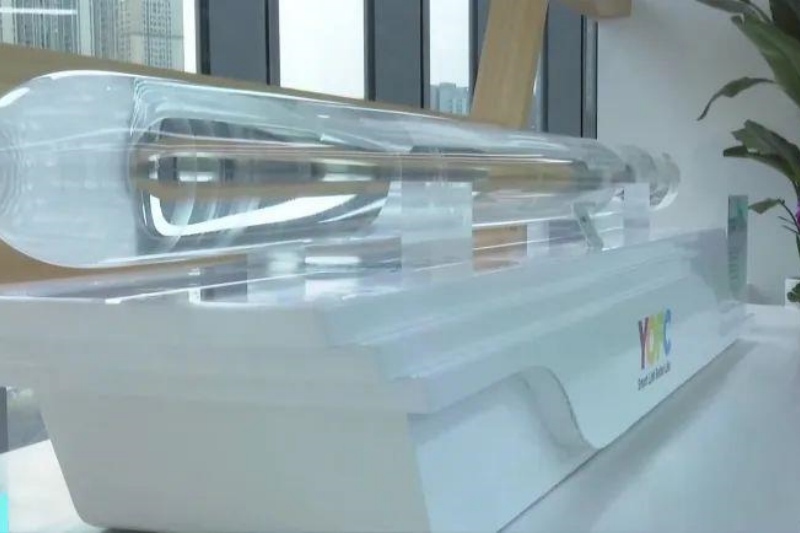
Philips wuxuu soo bandhigay PCVD 1975, and China’s YOFC now leads the world in it. Deposition still happens inside a silica tube, but microwaves generate plasma instead of a flame heating the wall from outside. Glass deposits directly at roughly 1000°C — low, as these processes go.
Precision is the whole argument for PCVD. The process lays down thousands of thin layers, which gives engineers micron-level command of the refractive index profile. That matters enormously for graded-index multimode fiber, where bandwidth depends on how faithfully the parabolic profile is reproduced. OM3, OM4 and OM5 are PCVD’s home territory.
Higher-power microwave sources have pushed PCVD deposition rates up considerably. It still loses to VAD and OVD on standard singlemode cost, and no amount of process tuning changes that.
You should specify PCVD when: you are drawing graded-index multimode or a specialty profile where bandwidth and profile fidelity, not glass cost, decide whether the fiber passes.
3. OVD: why scale and overcladding matter
Saddexdayada mid ka mid ah beddelaha isku xirka fiber indhaha ayaa la sameeyay OVD waxay soo saartay 1970, and it remains the most widely deployed fully synthetic process on earth. SiCl₄ and dopant gases react in an oxy-hydrogen flame, and the resulting silica powder deposits radially onto a rotating target rod.

What you get first is a porous soot boule, not glass. Operators pull out the target rod, then dehydrate and sinter the boule in a chlorine atmosphere at high temperature. That step closes the center hole and drives out water, leaving a transparent solid rod.
The early knock on OVD was water peak attenuation at 1383nm, traced to that center hole. The industry solved it — Corning’s SMF-28e line settled the argument years ago. If a competitor still cites center-hole water peak as a reason to avoid OVD, they are quoting 1990s literature.
OVD’s real position today is dual. It makes singlemode core rods, and it is the dominant overcladding technology worldwide, because high deposition rate plus very large preforms plus low cost is exactly what an overcladding step needs. Leading plants have also swapped SiCl₄ for chlorine-free siloxanes like OMCTS (D4) in the overcladding stage, cutting both cost and environmental load.
You should specify OVD when: you want the lowest-cost route to large standard singlemode preforms, or you are evaluating who does your overcladding — where OVD is the default answer at scale.

4. WAA MAXAY: mass production and low attenuation
Jabbaan NTT horumarinta VAD in 1977. It also runs on flame hydrolysis, but the geometry differs in a way that matters: the soot boule grows vertically along its own axis, from the bottom up, with no target rod involved.
Modern VAD splits deposition and consolidation into two machines — deposit the porous boule, then transfer it to a dedicated furnace for dehydration and sintering.

No target rod means no center hole to close. Internal purity comes out very high, which is why VAD is the method of choice for ultra-low-loss fiber. Axial growth also lends itself to continuous production rather than batch cycles. Ztt, Hengtong and Futong run VAD for the overwhelming majority of their singlemode core rods.
The catch is profile control. Shaping a complex refractive index profile axially is difficult, so VAD is a poor fit for graded-index multimode.
You should specify VAD when: you are producing standard or ultra-low-loss singlemode at volume and want the purest core glass per unit cost.

The decision matrix: parameter × application × buyer type
| Your situation | Core rod method | Dharka xad dhaafka ah | What actually governs your decision |
| Standard G.652.D singlemode, high volume | VAD or OVD | OVD (or RIC, see below) | Cost per km and yield per preform |
| Ultra-low-loss / long-haul, G.654.E | WAA MAXAY | OVD | Core purity, OH control, attenuation margin |
| OM3 / OM4 / Qaababka badan ee OM5 | PCVD | OVD or RIC | RI profile fidelity, bandwidth pass rate |
| Specialty: EDFA, PM, rad-hard | MCVD | Application-specific | Dopant control, small-batch flexibility |
| New plant, moderate planned capacity | VAD or PCVD | RIC is legitimate here | Capex per line, geometric consistency, time to first fiber |
| Qaybiyaha / trader qualifying a source | Ask, do not assume | Ask specifically | Batch-to-batch consistency, documented test data |
One line to carry away: the core rod method follows your fiber type; the overcladding method follows your cost structure and plant scale. Buyers who conflate the two end up comparing quotes that were never comparable.
From preform to fiber: why method choice compounds downstream

A preform is not the product. It is the input to a draw tower, and the tower magnifies every decision you made upstream.
A single large preform yields thousands of kilometers of continuous fiber, so longer drawable length per unit means fewer changeovers, less tower downtime, and better utilization on your most expensive asset. Geometric error does not average out either — the drawn fiber holds the exact core-to-cladding ratio and refractive index profile of the preform, scaled down to 125µm. Concentricity error you accepted in the preform arrives intact in every kilometer you draw, and you will meet it again as splice loss in the field.
Our end-to-end manufacturing guide walks the full chain from raw precursors through drawing, coating and testing if you need the downstream picture.
Bringing it together
Match the core rod method to the fiber you intend to sell:
- VAD or OVD for standard singlemode,
- VAD for ultra-low-loss,
- PCVD for graded-index multimode,
- MCVD for specialty doped glass.
Choose the overcladding route on cost structure and plant scale rather than on which method sounds most current. Then verify with measured data — attenuation, OH peak, xooga saarid, profile tolerance — because those numbers, not the acronym, tell you what you are buying.
Fibconet supplies optical fiber preforms alongside draw towers for manufacturers and new plant investors building or expanding a fiber line. If that is your situation, review our Qalabka Fiber-ka ah ee hore u-hagaajinta Qalabka Warshada page for process details and specifications.